
5.2
CiteScore
2.9
Impact Factor
Document Type : CASE STUDY
Authors
1 Department of Management and Engineering in Environmental Protection Education, L.N. Gumilyov Eurasian National University, Astana, Kazakhstan
2 Astana International University, Astana 010000, Kazakhstan
3 Abylkas Saginov Karaganda Technical University, Karaganda, Kazakhstan
4 Department of Environmental Engineering and Management, The University of Dodoma, 41218 Iyumbu, Dodoma, Tanzania
Graphical Abstract
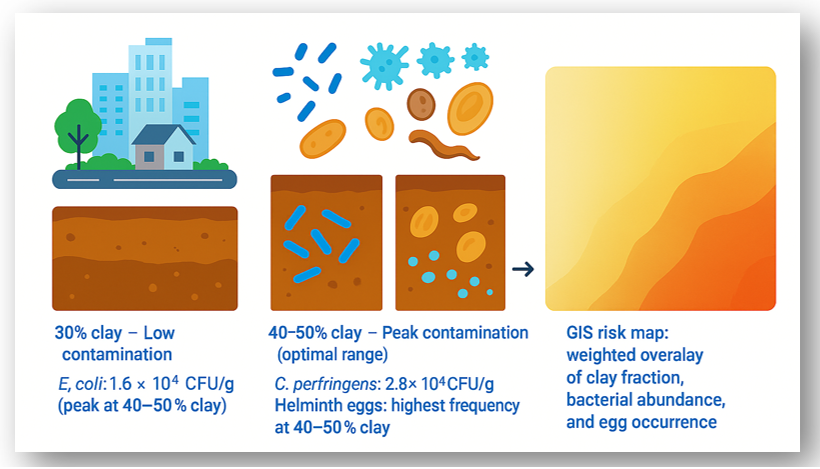
Highlights
Ø The soil clay content in Astana City shows a clear correlation with microbiological and helminthological contamination, confirming its role as a key environmental factor;
Ø Soils with moderate to high clay content (40–50%) were identified as optimal for the persistence and proliferation of key bacterial groups and helminth eggs;
Ø GIS-based spatial analysis effectively identified urban hotspots with elevated contamination risk, demonstrating the utility of geospatial tools for urban soil health monitoring;
Ø The integrated approach, combining granulometric analysis with microbiological and geospatial methods, provides a robust framework for urban public health planning and targeted soil management.
Keywords
OPEN ACCESS
©2026 The author(s). This article is licensed under a Creative Commons Attribution 4.0 International License, which permits use, sharing, adaptation, distribution and reproduction in any medium or format, as long as you give appropriate credit to the original author(s) and the source, provide a link to the Creative Commons license, and indicate if changes were made. The images or other third party material in this article are included in the article’s Creative Commons license, unless indicated otherwise in a credit line to the material. If material is not included in the article’s Creative Commons license and your intended use is not permitted by statutory regulation or exceeds the permitted use, you will need to obtain permission directly from the copyright holder. To view a copy of this license, visit: http://creativecommons.org/licenses/by/4.0/
PUBLISHER NOTE
GJESM Publisher remains neutral concerning jurisdictional claims in published maps and institutional affiliations.
MAJOR DATABASES, CITATION METRICS & CAPTURES
Google Scholar | Scopus - SJR | Web of Science | Biological Abstracts: Clarivate | Biosis Preview: Clarivate | PlumX Metrics | Altmetrics | Mendeley |
CURRENT PUBLISHER

| Article View | 1,244 |
| PDF Download | 862 |

Letters to Editor
[1] Letters that include statements of statistics, facts, research, or theories should include appropriate references, although more than three are discouraged.
[2] Letters that are personal attacks on an author rather than thoughtful criticism of the author’s ideas will not be considered for publication.
[3] Letters can be no more than 300 words in length.
[4] Letter writers should include a statement at the beginning of the letter stating that it is being submitted either for publication or not.
[5] Anonymous letters will not be considered.
[6] Letter writers must include their city and state of residence or work.
[7] Letters will be edited for clarity and length.