The significance of clean energy, education, and environmental management in fostering a sustainable future

Document Type : RESEARCH ARTICLE

Authors

1 Mechanical Engineering Program, Autonomous University of the Caribbean, Colombia

2 Doctorate Program in Engineering, Technological University of Bolívar, Colombia

Abstract
BACKGROUND AND OBJECTIVES: In Santa Cruz del Islote, an island located in the Colombian Caribbean, the lack of access to reliable electricity significantly affects the quality of life and educational opportunities of its inhabitants. The current reliance on polygeneration systems powered by diesel generators is economically unsustainable, environmentally harmful, and operationally unstable. The island experiences an average energy autonomy of only 11 hours. Therefore, this study aims to evaluate the feasibility of implementing renewable energy systems specifically solar and wind energy tailored to the island’s unique climatic and geographic conditions, with the goal of improving energy autonomy and promoting equitable access to education.
METHODS: The research involved the analysis of meteorological and energy data collected at the Santa Cruz del Islote to assess the potential of solar and wind resources. Solar irradiance levels were evaluated using historical data and the application of atmospheric transmittance models. Regarding wind behavior, it was analyzed through historical meteorological data, the development of wind rose diagrams, frequency analysis, and probability density functions. The study also included an assessment of the island's available renewable energy resources.
FINDINGS: The results indicate that Santa Cruz del Islote receives high levels of solar irradiance throughout the year, with average daily values around 4,290 and peak values exceeding 5,780 watt-hours per square meter. The wind behavior analysis revealed predominant directions toward the north and north-northeast, with average wind speeds ranging from 2.6 to 4.7 meters per second, suggesting the feasibility of harnessing this available renewable resource. However, wind potential varies seasonally, with lower availability from May to November. These findings support the design of hybrid renewable energy systems tailored to local conditions.
CONCLUSION: The study confirms that Santa Cruz del Islote possesses sufficient renewable energy potential to support a transition away from fossil fuels. Implementing clean energy technologies would not only reduce environmental impact and operational costs but also enhance educational infrastructure and digital access. The integration of sustainability, technological innovation, and social equity is essential for the long-term resilience and development of insular communities like Santa Cruz del Islote.

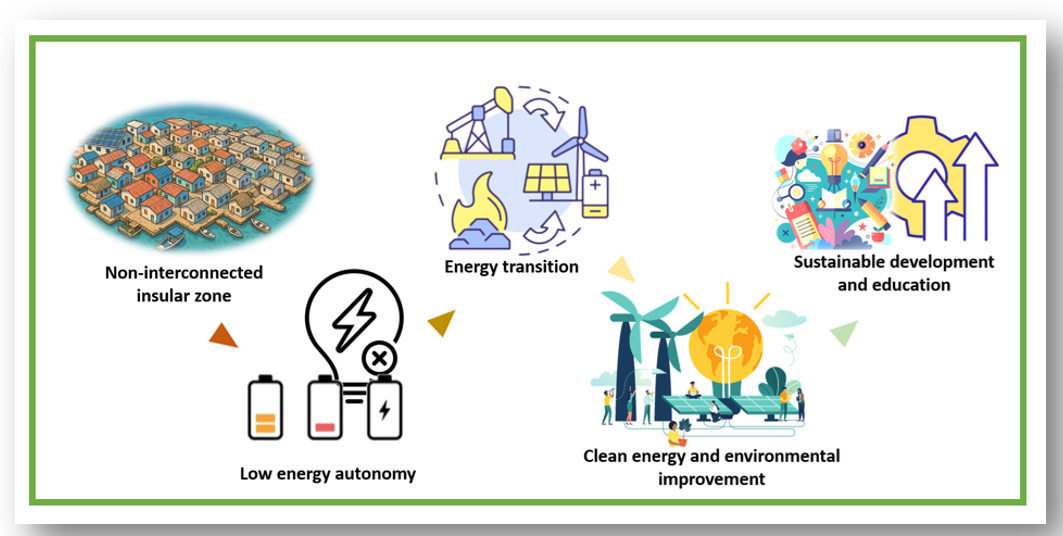
Graphical Abstract

The significance of clean energy, education, and environmental management in fostering a sustainable future

Highlights

  • Limited energy autonomy restricts access to essential services such as education and healthcare, highlighting the urgent need for a transition to renewable energy sources;
  • Meteorological data analysis reveals high potential for solar irradiation and favorable wind patterns;
  • Improving the energy supply would enable the use of educational technologies, ensure adequate refrigeration for food and medicines, and strengthen school infrastructure;
  • The study presents a comprehensive vision that integrates environmental sustainability through the energy transition;
  • The applied approach aligns with the Sustainable Development Goals (SDGs 4, 7, and 10) and supports the development of vulnerable island communities like Santa Cruz del Islote.

Keywords

Subjects

OPEN ACCESS

©2025 The author(s). This article is licensed under a Creative Commons Attribution 4.0 International License, which permits use, sharing, adaptation, distribution and reproduction in any medium or format, as long as you give appropriate credit to the original author(s) and the source, provide a link to the Creative Commons license, and indicate if changes were made. The images or other third party material in this article are included in the article’s Creative Commons license, unless indicated otherwise in a credit line to the material. If material is not included in the article’s Creative Commons license and your intended use is not permitted by statutory regulation or exceeds the permitted use, you will need to obtain permission directly from the copyright holder. To view a copy of this license, visit: 

http://creativecommons.org/licenses/by/4.0/


PUBLISHER NOTE

GJESM Publisher remains neutral concerning jurisdictional claims in published maps and institutional affiliations.


MAJOR DATABASES, CITATION METRICS & CAPTURES

Google Scholar | Scopus - SJR | Web of Science | Biological Abstracts: Clarivate | Biosis Preview: Clarivate | PlumX Metrics | Altmetrics | Mendeley |


CURRENT PUBLISHER

GJESM Publisher

Letters to Editor

GJESM Journal welcomes letters to the editor for the post-publication discussions and corrections which allows debate post publication on its site, through the Letters to Editor. Letters pertaining to manuscript published in GJESM should be sent to the editorial office of GJESM within three months of either online publication or before printed publication, except for critiques of original research. Following points are to be considering before sending the letters (comments) to the editor.

[1] Letters that include statements of statistics, facts, research, or theories should include appropriate references, although more than three are discouraged.
[2] Letters that are personal attacks on an author rather than thoughtful criticism of the author’s ideas will not be considered for publication.
[3] Letters can be no more than 300 words in length.
[4] Letter writers should include a statement at the beginning of the letter stating that it is being submitted either for publication or not.
[5] Anonymous letters will not be considered.
[6] Letter writers must include their city and state of residence or work.
[7] Letters will be edited for clarity and length.

Send comment about this article
Enter Name.
Enter a valid email address.
Enter a vaid affiliation.
Enter comments (At leaset 10 words)
CAPTCHA Image
Enter Security Code Correctly.
Volume 11, Issue 3 - Serial Number 43
Summer 2025
Pages 1001-1018


Article Podcasts

  • Receive Date 17 March 2025
  • Revise Date 19 May 2025
  • Accept Date 20 June 2025