Document Type : REVIEW PAPER
Authors
1
Doctoral Program in Fisheries Science and Marine, Faculty of Fisheries and Marine Sciences, Universitas Brawijaya East Java, Indonesia
2
Secondary Fisheries Business School, Jl Pantai Harapan, Tanggamus, Lampung, Indonesia
3
Department of Fishery Product Technology, Faculty of Fisheries and Marine Science, Brawijaya University, JL. Veteran, Malang 65415, East Java, Indonesia
4
Research Center for Marine and Inland Bioindustry, Research Organization of Earth and Maritime, National Research, and Innovation Agency, Serpong, Indonesia
Abstract
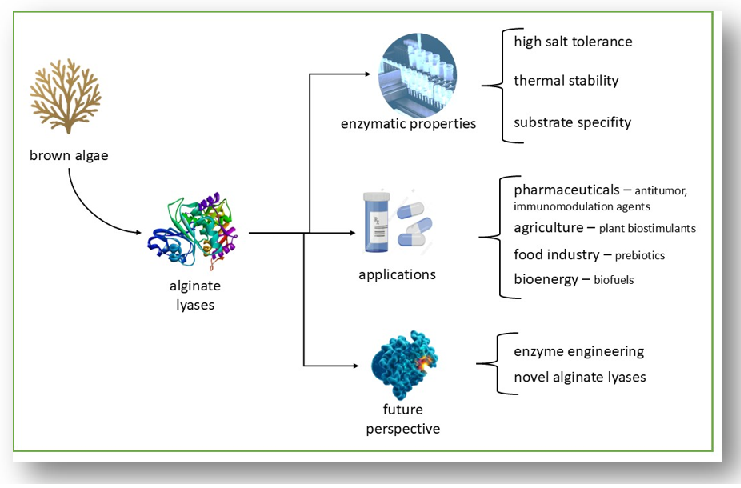
Alginate lyases are a class of enzymes capable of cleaving alginate, a major structural polysaccharide present in the cell walls of brown algae. In recent years, marine bacteria have emerged as a valuable and diverse source of these enzymes, owing to their unique adaptations to extreme marine conditions such as high salinity, variable potential of hydrogen, and fluctuating temperatures. Marine-derived alginate lyases exhibit remarkable enzymatic characteristics, including salt tolerance, thermal stability, substrate specificity, and diverse catalytic mechanisms, making them attractive for various industrial applications. The primary function of these enzymes lies in depolymerizing alginate into alginate oligosaccharides, which possess notable biological activities. Alginate oligosaccharides have shown significant potential across multiple sectors, such as pharmaceuticals (e.g., antitumor, immunomodulatory), agriculture (e.g., plant biostimulants), food (e.g., prebiotics), wastewater treatment, and bioenergy production. These applications are further enhanced by the enzymes’ compatibility with green processing technologies and sustainable resource utilization. This study provides a comprehensive overview of marine alginate lyases, focusing on their enzymatic properties, catalytic mechanisms, and industrial relevance. It also highlights future directions for their development and application. Advancements in molecular biology, protein engineering, and synthetic biology have accelerated the identification and development of novel alginate lyases, expanding the repertoire of polysaccharide lyase families. Furthermore, in-depth understanding of their β-elimination catalytic mechanisms—whether via histidine/tyrosine-based or metal ion-assisted pathways—has enabled enzyme engineering for improved performance under industrial conditions. Despite notable progress, challenges remain in achieving efficient large-scale production, enhancing enzyme robustness, and fine-tuning catalytic properties. This review discusses the enzymatic features, catalytic mechanisms, and emerging applications of alginate lyases from marine bacteria, while exploring future perspectives including biofilm degradation, wastewater treatment, and biodegradable materials. The strategic development of alginate lyases may play a vital role in advancing sustainable biotechnologies and circular bioeconomy. The study objectives were to offer an in-depth primer on recent advances in the discovery and characterization of alginate lyases from marine bacteria.
Graphical Abstract
Highlights
- Marine-derived alginate lyases show significant potential in industrial applications such as waste treatment and the production of sustainable biodegradable materials;
- The isolation and engineering of alginate lyases continue to advance, opening up opportunities for improved production efficiency and applications in biofuels and environmentally friendly biotechnological products;
- Recent studies have demonstrated that this enzyme can be used to produce alginate oligosaccharides (AOs), which are beneficial in various health and industrial applications.
Keywords
Subjects
OPEN ACCESS
©2025 The author(s). This article is licensed under a Creative Commons Attribution 4.0 International License, which permits use, sharing, adaptation, distribution and reproduction in any medium or format, as long as you give appropriate credit to the original author(s) and the source, provide a link to the Creative Commons license, and indicate if changes were made. The images or other third party material in this article are included in the article’s Creative Commons license, unless indicated otherwise in a credit line to the material. If material is not included in the article’s Creative Commons license and your intended use is not permitted by statutory regulation or exceeds the permitted use, you will need to obtain permission directly from the copyright holder. To view a copy of this license, visit:
http://creativecommons.org/licenses/by/4.0/
PUBLISHER NOTE
GJESM Publisher remains neutral concerning jurisdictional claims in published maps and institutional affiliations.
MAJOR DATABASES, CITATION METRICS & CAPTURES
Google Scholar | Scopus - SJR | Web of Science | Biological Abstracts: Clarivate | Biosis Preview: Clarivate | PlumX Metrics | Altmetrics | Mendeley |
CURRENT PUBLISHER
GJESM Publisher




Letters to Editor
[1] Letters that include statements of statistics, facts, research, or theories should include appropriate references, although more than three are discouraged.
[2] Letters that are personal attacks on an author rather than thoughtful criticism of the author’s ideas will not be considered for publication.
[3] Letters can be no more than 300 words in length.
[4] Letter writers should include a statement at the beginning of the letter stating that it is being submitted either for publication or not.
[5] Anonymous letters will not be considered.
[6] Letter writers must include their city and state of residence or work.
[7] Letters will be edited for clarity and length.