Document Type : CASE STUDY
Authors
1
Department of Civil Engineering, Sepuluh Nopember Institute of Technology, Surabaya, 60111, Indonesia
2
Department of Civil Engineering, Brawijaya University, Malang, 65145, Indonesia
3
Research Centre for Industrial Systems and Sustainable Manufacturing, National Research and Innovation Agency, Tangerang Selatan, 15314, Indonesia
Abstract
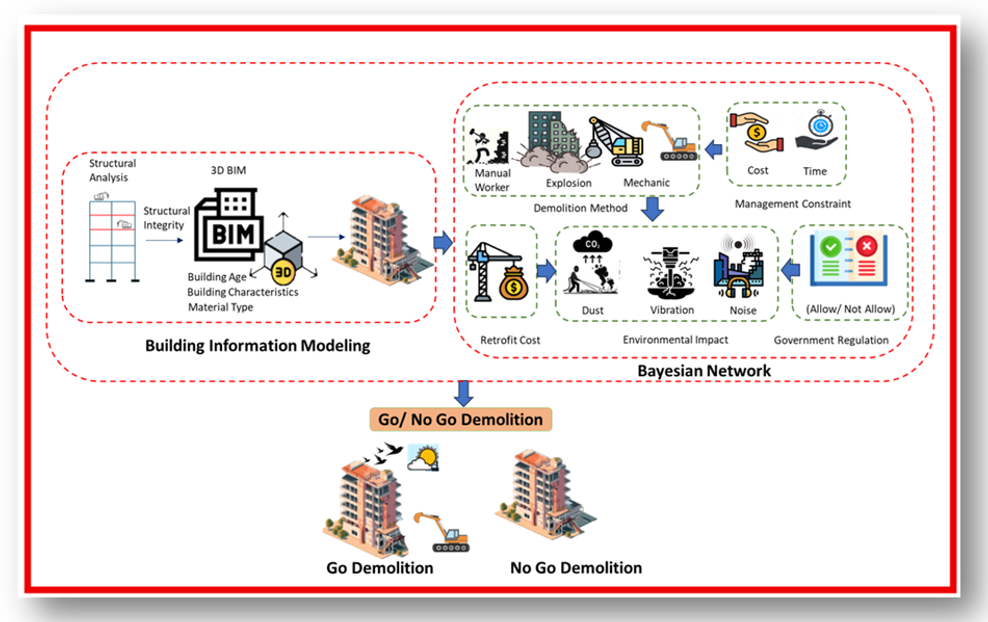
BACKGROUND AND OBJECTIVES: Decision-making in building demolition is complex, involving structural, environmental, economic, and regulatory considerations. Traditional approaches often rely on subjective judgment and lack data-driven analysis. This study seeks to create a comprehensive decision-support framework that integrates Building Information Modeling and Bayesian Networks to optimize go or no-go decision processes. The objectives of the study were to provide a more accurate, reliable, and systematic tool that improves planning, reduces uncertainty, and promotes safety, efficiency, and sustainability in building demolition practices.
METHODS: This study integrates Building Information Modeling data with Bayesian Network probabilistic analysis to assess structural, environmental, and managerial factors influencing demolition decisions. A case study was conducted on a three-story market building located in South Jakarta. Expert insights were utilized to create conditional probability tables, improving the model's precision and its applicability to actual demolition situations. The model was validated through simulation and sensitivity analysis, identifying key variables affecting go or no-go outcomes.
FINDINGS: The integrated Building Information Modeling–Bayesian Network model effectively supports go or no-go demolition decisions by addressing uncertainty and risk factors probabilistically. According to the case study findings, there is a 55.10 percent chance of demolition, influenced by inadequate structural integrity (70 percent) and significant retrofit costs (59 percent). Mechanical demolition was preferred (56 percent) for its efficiency and lower risk. Sensitivity analysis identified structural integrity, retrofit cost, building age, environmental impact, and permit status as key influencing variables. Validation by experts has established the model's practical importance, illustrating its potential to boost planning accuracy and encourage sustainable, data-centric decision-making in complex urban demolition endeavors.
CONCLUSION: Integrating Building Information Modeling and Bayesian Network improves demolition decision-making by addressing uncertainty and supporting risk-informed analysis. The model boosts the precision of planning and aids in pinpointing significant influencing factors, like structural integrity and the costs associated with retrofitting. Furthermore, it fosters sustainable, data-driven approaches, rendering it an effective tool for complicated urban demolition initiatives.
Graphical Abstract
Highlights
- A novel integration of Building Information Modeling and Bayesian Network enables probabilistic modeling of demolition feasibility, improving decision under uncertainty;
- Simulation results showed a 55.10% probability for Go Demolition, influenced significantly by poor structural integrity (70%) and high retrofit costs (59%);
- Structural condition, retrofit cost, building age, environmental impact, and permit status were determined to have the highest impact on demolition decisions in sensitivity analysis;
- The BIM-BN integration enhanced sustainable demolition practices by supporting material reuse, waste classification, and environmentally planning.
Keywords
Subjects
OPEN ACCESS
©2025 The author(s). This article is licensed under a Creative Commons Attribution 4.0 International License, which permits use, sharing, adaptation, distribution and reproduction in any medium or format, as long as you give appropriate credit to the original author(s) and the source, provide a link to the Creative Commons license, and indicate if changes were made. The images or other third party material in this article are included in the article’s Creative Commons license, unless indicated otherwise in a credit line to the material. If material is not included in the article’s Creative Commons license and your intended use is not permitted by statutory regulation or exceeds the permitted use, you will need to obtain permission directly from the copyright holder. To view a copy of this license, visit:
http://creativecommons.org/licenses/by/4.0/
PUBLISHER NOTE
GJESM Publisher remains neutral concerning jurisdictional claims in published maps and institutional affiliations.
MAJOR DATABASES, CITATION METRICS & CAPTURES
Google Scholar | Scopus - SJR | Web of Science | Biological Abstracts: Clarivate | Biosis Preview: Clarivate | PlumX Metrics | Altmetrics | Mendeley |
CURRENT PUBLISHER
GJESM Publisher




Letters to Editor
[1] Letters that include statements of statistics, facts, research, or theories should include appropriate references, although more than three are discouraged.
[2] Letters that are personal attacks on an author rather than thoughtful criticism of the author’s ideas will not be considered for publication.
[3] Letters can be no more than 300 words in length.
[4] Letter writers should include a statement at the beginning of the letter stating that it is being submitted either for publication or not.
[5] Anonymous letters will not be considered.
[6] Letter writers must include their city and state of residence or work.
[7] Letters will be edited for clarity and length.