Bibliometrics analysis and the role of nanocatalysts in wastewater remediation

Document Type : REVIEW PAPER

Authors

1 Department of Biotechnology, Saveetha School of Engineering, Saveetha Institute of Medical and Technical Sciences, Chennai- 602105, Tamil Nadu, India

2 Department of Biotechnology, Faculty of Science and Humanities, SRM Institute of Science and Technology, Ramapuram, Chennai 600089, Tamil Nadu, India

Abstract
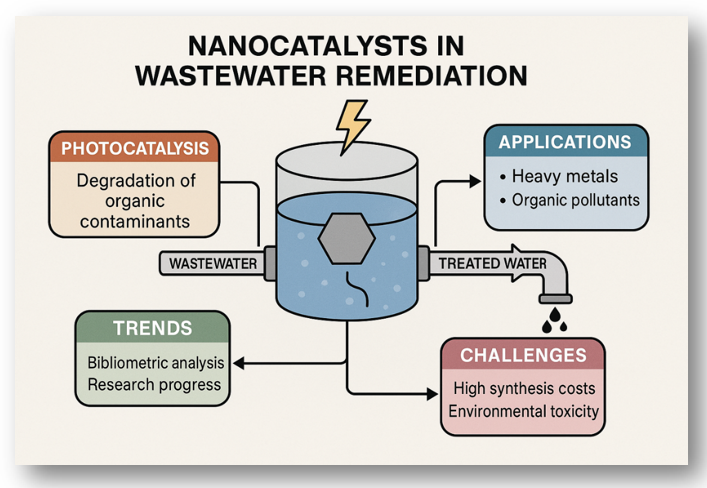
To address global concerns such as population expansion, urbanization, and industrialization, which are contributing to increased water pollution and shortages, sustainable water management relies on wastewater reuse. The purpose of this review is to investigate the significant role that hybrid catalytic materials and nanocatalysts play in the process of improving wastewater treatment technologies. By employing these materials and other advanced oxidation techniques, nanocatalysts are evaluated to assess their effectiveness in eliminating heavy metals and degrading persistent organic contaminants. The bibliometric assessment of research trends from 2015 to 2024 reveals a growing emphasis on the applications of nanotechnology in wastewater treatment. Within the scope of this review, the internal and extrinsic parameters that influence catalytic performance are investigated. These factors include particle size, light intensity, catalyst loading, and ambient pH conditions. Nanocatalysts hold great promise; however, several lingering concerns need to be addressed. These issues include high synthesis costs, scalability challenges, and environmental toxicity. These issues underscore the need to develop sustainable synthesis procedures, improved recovery mechanisms, and policy frameworks. Recent achievements in this sector include synthesizing nanomaterials that are safe for the environment, developing hybrid catalytic systems, and integrating these systems into existing treatment infrastructures to enhance efficiency and cost-effectiveness. The resolution of these issues will contribute to the establishment of nanocatalysts as transformative tools and green materials for wastewater treatment, for promoting the sustainability of water on a global scale and protecting the environment. The application of these hybrid materials for wastewater treatment is a topic of significant interest in environmental research.

Graphical Abstract

Bibliometrics analysis and the role of nanocatalysts in wastewater remediation

Highlights

  • The role of nanocatalysts in wastewater recycling, targeting efficiency and sustainability improvements in water management, is covered;
  • Nanocatalysts are highlighted for their advanced capabilities in wastewater treatment.
  • Hybrid catalytic materials are accredited for their multifunctional potential;
  • Innovative catalytic materials, integrating scientific advancements with practical applications enhances the piratical application of these materials for eco-friendly wastewater management.

Keywords

Subjects

OPEN ACCESS

©2025 The author(s). This article is licensed under a Creative Commons Attribution 4.0 International License, which permits use, sharing, adaptation, distribution and reproduction in any medium or format, as long as you give appropriate credit to the original author(s) and the source, provide a link to the Creative Commons license, and indicate if changes were made. The images or other third party material in this article are included in the article’s Creative Commons license, unless indicated otherwise in a credit line to the material. If material is not included in the article’s Creative Commons license and your intended use is not permitted by statutory regulation or exceeds the permitted use, you will need to obtain permission directly from the copyright holder. To view a copy of this license, visit: 

http://creativecommons.org/licenses/by/4.0/


PUBLISHER NOTE

GJESM Publisher remains neutral concerning jurisdictional claims in published maps and institutional affiliations.


MAJOR DATABASES, CITATION METRICS & CAPTURES

Google Scholar | Scopus - SJR | Web of Science | Biological Abstracts: Clarivate | Biosis Preview: Clarivate | PlumX Metrics | Altmetrics | Mendeley |


CURRENT PUBLISHER

GJESM Publisher

Letters to Editor

GJESM Journal welcomes letters to the editor for the post-publication discussions and corrections which allows debate post publication on its site, through the Letters to Editor. Letters pertaining to manuscript published in GJESM should be sent to the editorial office of GJESM within three months of either online publication or before printed publication, except for critiques of original research. Following points are to be considering before sending the letters (comments) to the editor.

[1] Letters that include statements of statistics, facts, research, or theories should include appropriate references, although more than three are discouraged.
[2] Letters that are personal attacks on an author rather than thoughtful criticism of the author’s ideas will not be considered for publication.
[3] Letters can be no more than 300 words in length.
[4] Letter writers should include a statement at the beginning of the letter stating that it is being submitted either for publication or not.
[5] Anonymous letters will not be considered.
[6] Letter writers must include their city and state of residence or work.
[7] Letters will be edited for clarity and length.

Send comment about this article
Enter Name.
Enter a valid email address.
Enter a vaid affiliation.
Enter comments (At leaset 10 words)
CAPTCHA Image
Enter Security Code Correctly.
Volume 11, Issue 3 - Serial Number 43
Summer 2025
Pages 1299-1318


Article Podcasts

  • Receive Date 27 February 2025
  • Revise Date 02 May 2025
  • Accept Date 01 June 2025