Document Type : CASE STUDY
Authors
1
Research Center for Veterinary Science, National Research and Innovation Agency, Cibinong 16911 Indonesia
2
Research Center for Marine and Land Bioindustry, National Research and Innovation Agency, Tangerang Selatan, 15310 Indonesia
3
Research Center for Food Technology and Processing, National Research and Innovation Agency, Gunungkidul 55681 Indonesia
4
Department of Biotechnology, Graduate School of Engineering, University of Osaka, 2-1 Yamada-Oka, 565-0871 Japan
5
Research Center for Oceanography, National Research and Innovation Agency, Jakarta 14430 Indonesia
6
Faculty of Fisheries and Marine Science, Padjadjaran University, Sumedang 45363 Indonesia
7
School of Environmental Science, Universitas Indonesia, Jakarta 10430 Indonesia
8
Faculty of Food Technology and Health, Sahid University, Jl., Jakarta 12870, Indonesia
Abstract
BACKGROUND AND OBJECTIVES: Trace elements and pesticide residues are among the crucial problems in the river Watershed ecosystem. The present study aimed to assess the health risk of trace elements and organochlorines to the local inhabitants from fish consumption in Citarum Watershed, Indonesia. This study is important as the rapid development of population and industrial activities along Citarum Watershed has contributed to domestic waste production, agricultural run-off, and industrial emissions that could leak into the river watershed.
METHODS: This risk assessment was conducted based on the framework according to the Codex Alimentarius Commission. The concentrations of selected trace elements and organochlorines in fish species from Citarum Watershed were obtained from fish farms in 3 reservoirs (Saguling, Cirata, and Jatiluhur). Data on food consumption used to estimate the contaminant exposure were obtained from individual food consumption surveys of the National Total Diet Study conducted by the Ministry of Health. A deterministic approach was used to estimate the dietary exposure to trace elements and organochlorine pesticides from fish consumption related to the Citarum Watershed in different age groups of the local population. The health risk evaluation is classified into both chronic/non-carcinogenic health risks (hazard quotient) and carcinogenic risk.
FINDINGS: The study found that trace elements and organochlorine pesticides were detected in freshwater fish from Citarum Watershed with concentration orders of copper > chrome > lead > mercury > cadmium. The concentrations are generally below the maximum permissible limit according to Indonesian and global regulations. Additionally, organochlorine levels in fish samples were also relatively low compared to the official threshold, with concentration order of heptachlor > lindane > dichloro-diphenyl-trichloroethane > endosulfan > aldrin > endrin > dieldrin, respectively. Chrome and lead showed the highest contributors for non-carcinogenic and carcinogenic risks from trace element exposure, respectively. Additionally, aldrin and heptachlor are the main contributors for non-carcinogenic and carcinogenic risks from organochlorine exposure, respectively.
CONCLUSION: The present study revealed that trace elements and organochlorines are unlikely to pose non-carcinogenic and carcinogenic risks to the local populations in Citarum Watershed. However, the worst estimation of cumulative exposure showed that the child population is susceptible to the highest risk. The result of the present study is considered as the lowest risk scenario. Additionally, if there is no improved mitigation program to reduce contamination to Citarum Watershed, there is a possible increased health risks to the local population. There is possible additional risk from other contaminants and other dietary sources, as well as the possible synergistic toxicity among the compounds. To provide a more reliable health risk, further research is required to identify the contamination in wild fish and other dietary sources, as well as to include emerging contaminants. Furthermore, it is important to the related governmental bodies to establish a regular monitoring program as well as to monitor the biota samples. Identification of contaminant sources is important to develop a mitigation strategy and law enforcement for minimizing the use and leakage of the contaminants in the ecosystem and reducing the hazards to public health.
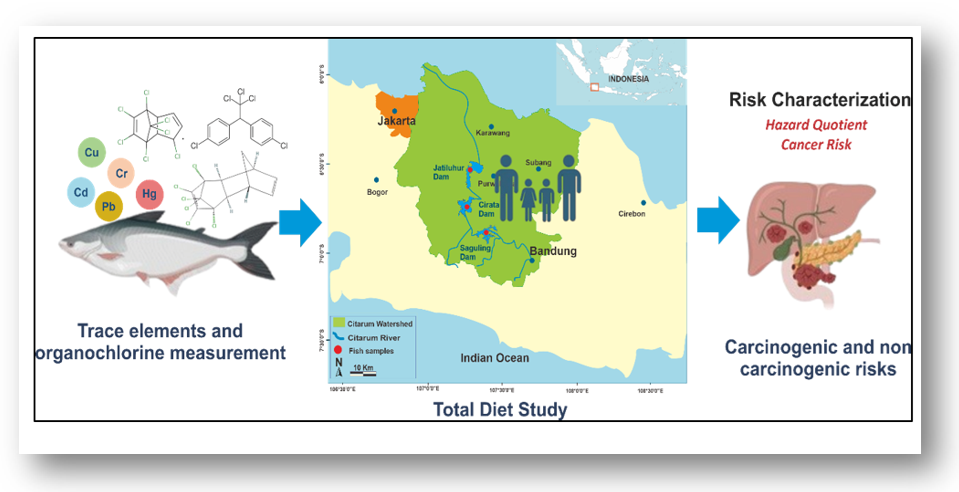
Graphical Abstract
Highlights
- A comprehensive multi-contaminants assessment of trace elements and organochlorine pesticides exposure from freshwater fish consumption in tropical ecosystem;
- The concentration orders of trace elements in fish was Cu > Cr > Pb > Hg > Cd, while the organochlorines were heptachlor > lindane > DDT > endosulfan > aldrin > endrin > dieldrin;
- Cr and aldrin are the highest contributors for non-carcinogenic risk, while Pb and heptachlor are the main contributors for carcinogenic risk;
- More attention should be paid to the child population (0-12 years old) due to the higher risk than the other age groups.
Keywords
Subjects
OPEN ACCESS
©2025 The author(s). This article is licensed under a Creative Commons Attribution 4.0 International License, which permits use, sharing, adaptation, distribution and reproduction in any medium or format, as long as you give appropriate credit to the original author(s) and the source, provide a link to the Creative Commons license, and indicate if changes were made. The images or other third party material in this article are included in the article’s Creative Commons license, unless indicated otherwise in a credit line to the material. If material is not included in the article’s Creative Commons license and your intended use is not permitted by statutory regulation or exceeds the permitted use, you will need to obtain permission directly from the copyright holder. To view a copy of this license, visit:
http://creativecommons.org/licenses/by/4.0/
PUBLISHER NOTE
GJESM Publisher remains neutral concerning jurisdictional claims in published maps and institutional affiliations.
MAJOR DATABASES, CITATION METRICS & CAPTURES
Google Scholar | Scopus - SJR | Web of Science | Biological Abstracts: Clarivate | Biosis Preview: Clarivate | PlumX Metrics | Altmetrics | Mendeley |
CURRENT PUBLISHER
GJESM Publisher



Letters to Editor
[1] Letters that include statements of statistics, facts, research, or theories should include appropriate references, although more than three are discouraged.
[2] Letters that are personal attacks on an author rather than thoughtful criticism of the author’s ideas will not be considered for publication.
[3] Letters can be no more than 300 words in length.
[4] Letter writers should include a statement at the beginning of the letter stating that it is being submitted either for publication or not.
[5] Anonymous letters will not be considered.
[6] Letter writers must include their city and state of residence or work.
[7] Letters will be edited for clarity and length.