Passenger car emissions in urban areas based on local vehicle fleet and environmental conditions

Document Type : CASE STUDY

Authors

Air Engineering Studies Research Group, CINEMI, Universidad Tecnológica de Panamá

Abstract
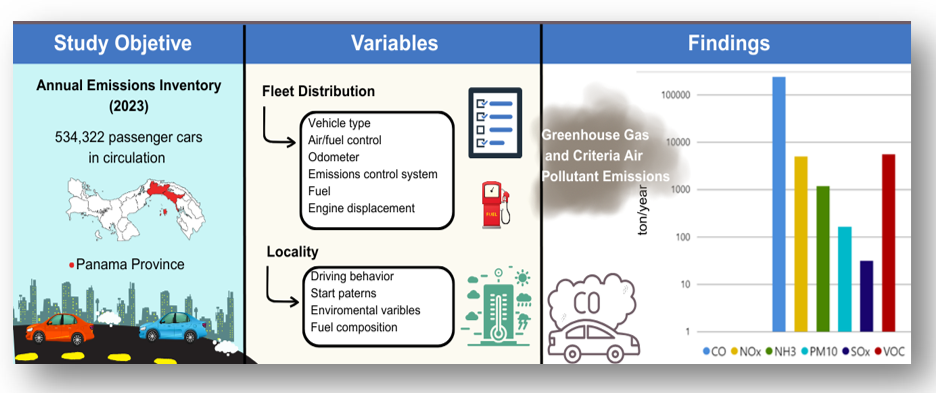
BACKGROUND AND OBJECTIVES: For air quality management, appropriate emission inventories are required to be categorized on-road mobile sources such as cars, depending on their use, vehicle technology, and local environmental conditions. This study aims to estimate atmospheric pollutant emissions generated by passenger cars using the international vehicle emission model for the year 2023.
METHODS: To implement the international vehicle emission model and develop a baseline for an emissions inventory, vehicle technology in the study area was identified through surveys at filling fuel stations in the two districts with the highest traffic. The fleet was categorized based on parameters such as emission control technology, fuel type, and engine displacement. Additionally, the study considered geographic and environmental variables, including travel patterns on urban roads, fuel specifications, and elevation.
FINDINGS: 53 vehicle categories were identified across the province and classified within the international vehicle emission model. After setting the fleet file with the distribution of vehicle categories and the location file with environmental conditions and representative characteristics, the model estimated atmospheric pollutant emissions for 2023 in metric tons. Passenger cars contributed the most to pollutant emissions, with carbon dioxide reaching 1.78 million tons per year and carbon monoxide 234.16 kiloton per year. Regarding emission factors, gasoline vehicles showed a proportional increase in carbon dioxide, nitrous oxide, nitrogen oxides, and sulfur oxides emissions per kilometer as vehicle size increased. A notable case was carbon monoxide emissions, where a medium-sized vehicle emitted approximately 41 grams per kilometer—twice the amount of a heavy car as 23 grams per kilometer, according to international vehicle emission model estimation. Particulate matter emissions were primarily generated by heavy passenger vehicles, compared with light and medium cars, whose emissions were 90 percent and 83 percent, respectively.
CONCLUSION: This study developed an on-road mobile source emission inventory for 2023, focusing on passenger cars in Panama. A survey of 409 vehicles characterized a fleet of 534,322 cars, identifying 53 categories, with 94.8 percent running on gasoline and 5.12 percent on diesel. More than 45 percent of the vehicles exceed 160,000 kilometers, increasing their emissions. Medium-sized cars (1.5–3 liters) account for 61.1 percent of the fleet and are the largest emitters of carbon dioxide and nitrogen oxide. Although fewer in number, diesel vehicles produce nearly half of the particulate matter-10 emissions. Comparisons with national and international inventories validate the contribution of these vehicles to air pollution and the impact of each pollutant. 

Graphical Abstract

Passenger car emissions in urban areas based on local vehicle fleet and environmental conditions

Highlights

  • Carbon dioxide is the main greenhouse gas emitted, reaching 1.78 million tons per year;
  • The emissions estimation conducted using the IVE model shows that diesel-fueled vehicles are the primary contributors to particulate matter emissions;
  • When comparing cities, Panama Province demonstrates the highest vehicle-to-population ratio, with 371 vehicles per 1,000 inhabitants;
  • Approximately 79% of carbon monoxide emissions are estimated to come from automobiles with more than 161,000 km.

Keywords

Subjects

OPEN ACCESS

©2025 The author(s). This article is licensed under a Creative Commons Attribution 4.0 International License, which permits use, sharing, adaptation, distribution and reproduction in any medium or format, as long as you give appropriate credit to the original author(s) and the source, provide a link to the Creative Commons license, and indicate if changes were made. The images or other third party material in this article are included in the article’s Creative Commons license, unless indicated otherwise in a credit line to the material. If material is not included in the article’s Creative Commons license and your intended use is not permitted by statutory regulation or exceeds the permitted use, you will need to obtain permission directly from the copyright holder. To view a copy of this license, visit: 

http://creativecommons.org/licenses/by/4.0/


PUBLISHER NOTE

GJESM Publisher remains neutral concerning jurisdictional claims in published maps and institutional affiliations.


MAJOR DATABASES, CITATION METRICS & CAPTURES

Google Scholar | Scopus - SJR | Web of Science | Biological Abstracts: Clarivate | Biosis Preview: Clarivate | PlumX Metrics | Altmetrics | Mendeley |


CURRENT PUBLISHER

GJESM Publisher

Letters to Editor

GJESM Journal welcomes letters to the editor for the post-publication discussions and corrections which allows debate post publication on its site, through the Letters to Editor. Letters pertaining to manuscript published in GJESM should be sent to the editorial office of GJESM within three months of either online publication or before printed publication, except for critiques of original research. Following points are to be considering before sending the letters (comments) to the editor.

[1] Letters that include statements of statistics, facts, research, or theories should include appropriate references, although more than three are discouraged.
[2] Letters that are personal attacks on an author rather than thoughtful criticism of the author’s ideas will not be considered for publication.
[3] Letters can be no more than 300 words in length.
[4] Letter writers should include a statement at the beginning of the letter stating that it is being submitted either for publication or not.
[5] Anonymous letters will not be considered.
[6] Letter writers must include their city and state of residence or work.
[7] Letters will be edited for clarity and length.

Send comment about this article
Enter Name.
Enter a valid email address.
Enter a vaid affiliation.
Enter comments (At leaset 10 words)
CAPTCHA Image
Enter Security Code Correctly.
Volume 11, Issue 3 - Serial Number 43
Summer 2025
Pages 1079-1096


Article Podcasts

  • Receive Date 07 February 2025
  • Revise Date 25 April 2025
  • Accept Date 25 May 2025