Document Type : CASE STUDY
Authors
1
Electrical and Electronics Engineering Department, College of Engineering, Mindanao State University – General Santos, Fatima, 9500 General Santos City, Philippines
2
Mechanical Engineering Department, College of Engineering, Mindanao State University – General Santos, Fatima, 9500 General Santos City, Philippines
Abstract
BACKGROUND AND OBJECTIVES: The Coronavirus 2019 pandemic has revealed significant shortcomings in the Philippines’ solid waste management system, particularly in addressing the surge of pandemic-related waste. Unreliable waste collection, insufficient public knowledge, and improper waste disposal practices have exacerbated risks to the environment and public health. Despite these concerns, the specific impacts of Coronavirus 2019 pandemic related waste on human health and the environment in the Philippines’ context remain underexplored. This study aims to quantify Coronavirus 2019 related waste generated from both household sources and non-household establishments, assess disposal practices, characterize waste composition, determine generation rates, and classify waste types. Moreover, a comprehensive waste flow analysis will be carried out to monitor the movement of both appropriately and inappropriately managed Coronavirus 2019 waste, examining its implications on terrestrial and aquatic environments, as well as public health. Insights from the Philippines can significantly contribute to the formulation of resilient and adaptive waste management approaches in response to future public health emergencies worldwide.
METHODS: Coronavirus 2019 pandemic related waste generation from both household sources and non-household establishments was quantified through a 5-day at-source waste analysis and characterization study conducted in twenty-six urban and rural barangays of General Santos City. The determination of sample sizes was conducted using conventional statistical techniques, informed by the most up-to-date census data and business establishment profiles. Structured questionnaires and checklists were used to gather information from household respondents regarding Coronavirus 2019 related waste sources, generation rates, and disposal behaviors. To determine the degree of environmental contamination related to pandemic waste, further waste characterization was carried out in the Silway and Makar Rivers, two key urban waterways that pass through populated and commercial districts prior to their discharge into Sarangani Bay.
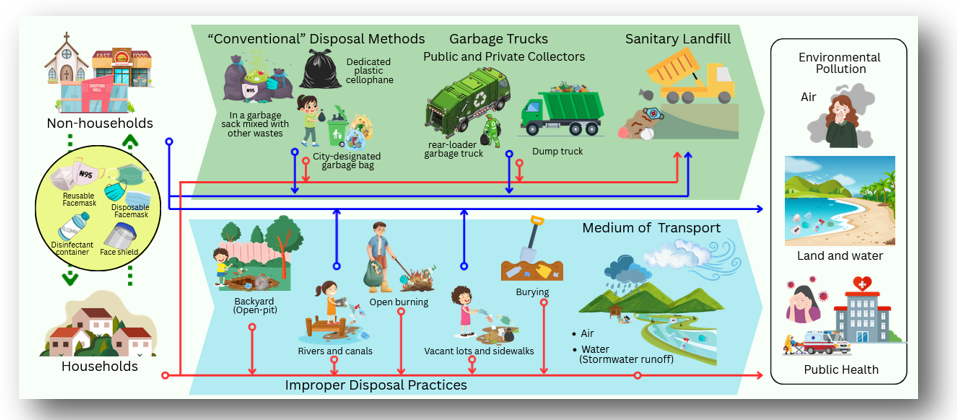
FINDINGS: According to the Waste Analysis and Characterization Study, waste linked to the Coronavirus 2019 pandemic totals about 52,877.7 kilograms per day, which is equivalent to 1.57 percent of the city’s total daily waste. This equates to an estimated 4,654,720 discarded face masks from household sources and 633,050 from non-household establishments daily. Coronavirus 2019 pandemic related waste density in the Makar and Silway Rivers-tributaries of the Sarangani Bay Protected Seascape was recorded at 0.238 gram per square meters and 0.706 gram per square meters, respectively. Mainly consisting of plastic face masks, this waste poses environmental threats as possible microplastic sources, jeopardizing both marine environments and human well-being. Waste flow analysis illustrated the management pathways of Coronavirus 2019 pandemic-related waste, underscoring its significant environmental and social repercussions.
CONCLUSION: The Coronavirus 2019 pandemic has highlighted critical gaps in waste management systems and the environmental and health hazards associated with emerging waste streams such as Coronavirus 2019. Mismanagement of this waste stream results in environmental damage and considerable threats to public health. The study emphasizes the pressing requirement for better waste governance, infrastructure enhancements, and public education to reduce the enduring effects of waste associated with the pandemic.
Graphical Abstract
Highlights
- Household and non-household establishments generated significant amounts of COVID-19 pandemic-related waste, contributing markedly to daily waste accumulation;
- Inadequate disposal measures and inconsistent waste collection have resulted in illicit disposal practices, heightening environmental and public health risks;
- Appropriate policy interventions, improved waste segregation, and enhanced collection systems are essential to mitigate long-term environmental impacts.
Keywords
Subjects
OPEN ACCESS
©2025 The author(s). This article is licensed under a Creative Commons Attribution 4.0 International License, which permits use, sharing, adaptation, distribution and reproduction in any medium or format, as long as you give appropriate credit to the original author(s) and the source, provide a link to the Creative Commons license, and indicate if changes were made. The images or other third party material in this article are included in the article’s Creative Commons license, unless indicated otherwise in a credit line to the material. If material is not included in the article’s Creative Commons license and your intended use is not permitted by statutory regulation or exceeds the permitted use, you will need to obtain permission directly from the copyright holder. To view a copy of this license, visit:
http://creativecommons.org/licenses/by/4.0/
PUBLISHER NOTE
GJESM Publisher remains neutral concerning jurisdictional claims in published maps and institutional affiliations.
MAJOR DATABASES, CITATION METRICS & CAPTURES
Google Scholar | Scopus - SJR | Web of Science | Biological Abstracts: Clarivate | Biosis Preview: Clarivate | PlumX Metrics | Altmetrics | Mendeley |
CURRENT PUBLISHER
GJESM Publisher




Letters to Editor
[1] Letters that include statements of statistics, facts, research, or theories should include appropriate references, although more than three are discouraged.
[2] Letters that are personal attacks on an author rather than thoughtful criticism of the author’s ideas will not be considered for publication.
[3] Letters can be no more than 300 words in length.
[4] Letter writers should include a statement at the beginning of the letter stating that it is being submitted either for publication or not.
[5] Anonymous letters will not be considered.
[6] Letter writers must include their city and state of residence or work.
[7] Letters will be edited for clarity and length.