Sustainable approach for biocontrol of biostimulants derived from endophytic bacteria and seaweed extracts

Document Type : CASE STUDY

Authors

1 Research Centre of Horticulture, National Research and Innovation Agency, Jl., Cibinong, Bogor, West Java 16911, Indonesia

2 Research Center for Applied Microbiology, National Research and Innovation Agency, KST Soekarno, Jl. Raya Jakarta-Bogor, Cibinong, West Java 16915, Indonesia

Abstract
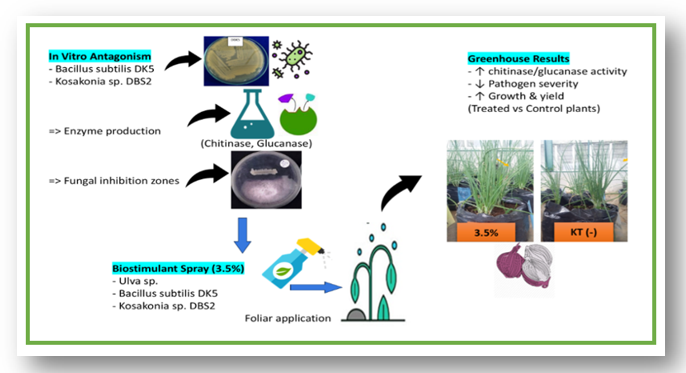
BACKGROUND AND OBJECTIVES: Shallot yields are significantly threatened by Fusarium wilt disease, caused by the fungus Fusarium oxysporum f.sp. cepae. Current control strategies primarily rely on synthetic fungicides and traditional cultural practices. To find a more sustainable and cost-effective alternative, this research explored the potential of microbial biocontrol. The objective of this study is to investigate the effectiveness of a biostimulant mixture composed of a seaweed extract from Ulva sp. and two endophytic bacteria isolates (Bacillus subtilis DK5 and Kosakonia sp. DBS2) in controlling shallot wilt disease.
METHODS: The effectiveness of this formulation was evaluated through assessments of bacterial antagonism, fungal mortality rates, and the biostimulant's production capabilities.
FINDINGS: The findings of this study underscore the potential of endophytic bacterial isolates, particularly Bacillus subtilis DK5 and Kosakonia sp. DBS2 inhibits the growth of Fusarium oxysporum f.sp. cepae in vitro and suppresses wilt disease in shallot plants. Results indicated that the formulated biostimulants significantly inhibited pathogen growth across various concentrations. In vitro testing showed that a 2.5 percent biostimulant treatment led to a greater Fusarium oxysporum f.sp. cepae growth reduction than the control. Furthermore, under greenhouse conditions, the treated group exhibited significantly lower wilt disease severity (Probability ≤ 0.05) than the control group, suggesting that the biostimulant formulation effectively suppressed the disease.
CONCLUSION: The bacteria demonstrated significant antagonistic activity and compatibility, making them ideal candidates for inclusion in a biostimulant formulation. When combined with Ulva sp. extract, the biostimulant mixture not only reduced disease severity by up to 58.76 percent but also enhanced key agronomic parameters such as plant height, leaf number, clump weight, and tuber dry weight, most notably at the 3.5 percent concentration. The biostimulant’s efficacy is likely due to both antimicrobial effects and growth-promoting properties, including improved nutrient uptake and phytohormone production.
This study provides promising evidence for the integrated use of microbial and seaweed-based biostimulants as a sustainable alternative for managing Fusarium wilt and improving the productivity of shallot cultivation within a greenhouse environment.

Graphical Abstract

Sustainable approach for biocontrol of biostimulants derived from endophytic bacteria and seaweed extracts

Highlights

  • 5% biostimulant formulation significantly inhibited the growth of Foc in vitro;
  • Greenhouse application of the biostimulant resulted in a significant reduction in wilt disease severity (P ≤ 0.05), with up to 58.76% suppression observed at the 3.5% concentration;
  • Treated plants also showed improvement in growth parameters, including increased plant height, number of leaves, clump weight, and tuber dry weight;
  • The study supports the integrated use of microbial and seaweed-based biostimulants as an eco-friendly and effective alternative to chemical fungicides for managing Fusarium wilt in shallots, under greenhouse conditions.

Keywords

Subjects

OPEN ACCESS

©2025 The author(s). This article is licensed under a Creative Commons Attribution 4.0 International License, which permits use, sharing, adaptation, distribution and reproduction in any medium or format, as long as you give appropriate credit to the original author(s) and the source, provide a link to the Creative Commons license, and indicate if changes were made. The images or other third party material in this article are included in the article’s Creative Commons license, unless indicated otherwise in a credit line to the material. If material is not included in the article’s Creative Commons license and your intended use is not permitted by statutory regulation or exceeds the permitted use, you will need to obtain permission directly from the copyright holder. To view a copy of this license, visit: 

http://creativecommons.org/licenses/by/4.0/


PUBLISHER NOTE

GJESM Publisher remains neutral concerning jurisdictional claims in published maps and institutional affiliations.


MAJOR DATABASES, CITATION METRICS & CAPTURES

Google Scholar | Scopus - SJR | Web of Science | Biological Abstracts: Clarivate | Biosis Preview: Clarivate | PlumX Metrics | Altmetrics | Mendeley |


CURRENT PUBLISHER

GJESM Publisher

Letters to Editor

GJESM Journal welcomes letters to the editor for the post-publication discussions and corrections which allows debate post publication on its site, through the Letters to Editor. Letters pertaining to manuscript published in GJESM should be sent to the editorial office of GJESM within three months of either online publication or before printed publication, except for critiques of original research. Following points are to be considering before sending the letters (comments) to the editor.

[1] Letters that include statements of statistics, facts, research, or theories should include appropriate references, although more than three are discouraged.
[2] Letters that are personal attacks on an author rather than thoughtful criticism of the author’s ideas will not be considered for publication.
[3] Letters can be no more than 300 words in length.
[4] Letter writers should include a statement at the beginning of the letter stating that it is being submitted either for publication or not.
[5] Anonymous letters will not be considered.
[6] Letter writers must include their city and state of residence or work.
[7] Letters will be edited for clarity and length.

Send comment about this article
Enter Name.
Enter a valid email address.
Enter a vaid affiliation.
Enter comments (At leaset 10 words)
CAPTCHA Image
Enter Security Code Correctly.
Volume 11, Issue 3 - Serial Number 43
Summer 2025
Pages 1281-1298


Article Podcasts

  • Receive Date 09 January 2025
  • Revise Date 14 March 2025
  • Accept Date 19 May 2025