The impact of renewable energy technology innovation on the low-carbon economic transition

Document Type : CASE STUDY

Authors

School of Economics, Hebei university, Baoding 071000, China

Abstract
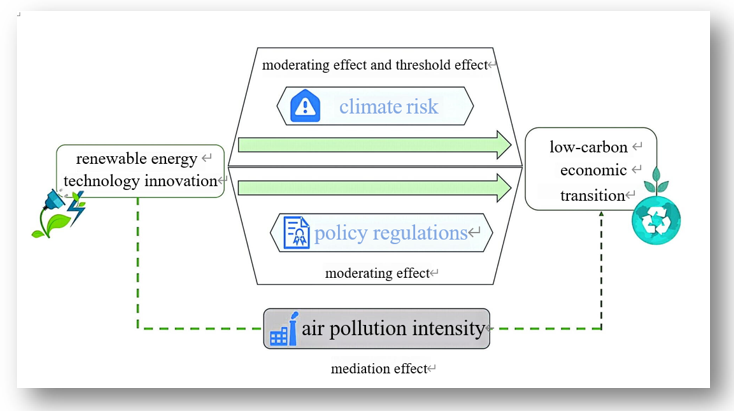
BACKGROUND AND OBJECTIVES: In the context of sustainable development, renewable energy technology innovation is not only a vital approach for enhancing energy efficiency but also a critical driver of low-carbon economic transition. Throughout this process, the importance of climate risks and policy regulations has become increasingly apparent. This study aims to empirically examine the impact of renewable energy technology innovation on the transition to a low-carbon economic with a particular focus on the roles of climate risks and policy regulations.
METHODS: This study establishes a benchmark regression model to empirically examine the impact of renewable energy technology innovation on low-carbon economic transition, analyzing panel data from 30 Chinese provinces from 2000 to 2021. Subsequently, it is investigated the critical role of climate risk through moderating and threshold effect. Furthermore, a difference-in-differences model is constructed to evaluate the efficacy of policy interventions in this transformative process. Finally, mediation analysis is conducted to assess the intermediary effects of air pollution intensity.
FINDINGS: The benchmark regression analysis revealed a statistically significant negative association between renewable energy technology innovation and low-carbon economic transition. Moderating effect tests demonstrated a positive coefficient for the interaction term, indicating that climate risk exerts a constraining effect on the progression. Threshold regression results further suggested that heightened climate risk levels progressively amplify its constraining effect. difference-in-differences estimation confirmed the significant efficacy of policy interventions in accelerating the transition dynamics. The intermediary effect shows that air pollution intensity plays an intermediary role in the progression.
CONCLUSION: 1) renewable energy technology innovation contributes to low-carbon economic transition, and this effect remains consistent after a series of robustness tests; 2) climate risk has a negative moderating effect and a threshold effect on the transition to a low-carbon economic nexus is evident; 3) policy regulation can significantly promote low-carbon economic transition. Additionally, it is found that renewable energy technology innovation promotes low-carbon economic transition by reducing air pollution intensity. Renewable energy technology innovation has a more significant effect on the low-carbon economic transition in regions with higher levels of economic development.

Graphical Abstract

The impact of renewable energy technology innovation on the low-carbon economic transition

Highlights

  • RETI can significantly promote LCET. This finding is supported by several robustness tests;
  • Climate risks hinder the process by which RETI promotes the LCET;
  • The Paris Agreement policy significantly promotes LCET;
  • RETI significantly promotes the LCET by reducing air pollution intensity;
  • In more economically developed provinces, RETI significantly promotes the LCET. In contrast, the effect is negligible in areas of lesser economic advancement.

Keywords

Subjects

OPEN ACCESS

©2025 The author(s). This article is licensed under a Creative Commons Attribution 4.0 International License, which permits use, sharing, adaptation, distribution and reproduction in any medium or format, as long as you give appropriate credit to the original author(s) and the source, provide a link to the Creative Commons license, and indicate if changes were made. The images or other third party material in this article are included in the article’s Creative Commons license, unless indicated otherwise in a credit line to the material. If material is not included in the article’s Creative Commons license and your intended use is not permitted by statutory regulation or exceeds the permitted use, you will need to obtain permission directly from the copyright holder. To view a copy of this license, visit: 

http://creativecommons.org/licenses/by/4.0/


PUBLISHER NOTE

GJESM Publisher remains neutral concerning jurisdictional claims in published maps and institutional affiliations.


MAJOR DATABASES, CITATION METRICS & CAPTURES

Google Scholar | Scopus - SJR | Web of Science | Biological Abstracts: Clarivate | Biosis Preview: Clarivate | PlumX Metrics | Altmetrics | Mendeley |


CURRENT PUBLISHER

GJESM Publisher

Letters to Editor

GJESM Journal welcomes letters to the editor for the post-publication discussions and corrections which allows debate post publication on its site, through the Letters to Editor. Letters pertaining to manuscript published in GJESM should be sent to the editorial office of GJESM within three months of either online publication or before printed publication, except for critiques of original research. Following points are to be considering before sending the letters (comments) to the editor.

[1] Letters that include statements of statistics, facts, research, or theories should include appropriate references, although more than three are discouraged.
[2] Letters that are personal attacks on an author rather than thoughtful criticism of the author’s ideas will not be considered for publication.
[3] Letters can be no more than 300 words in length.
[4] Letter writers should include a statement at the beginning of the letter stating that it is being submitted either for publication or not.
[5] Anonymous letters will not be considered.
[6] Letter writers must include their city and state of residence or work.
[7] Letters will be edited for clarity and length.

Send comment about this article
Enter Name.
Enter a valid email address.
Enter a vaid affiliation.
Enter comments (At leaset 10 words)
CAPTCHA Image
Enter Security Code Correctly.
Volume 11, Issue 3 - Serial Number 43
Summer 2025
Pages 1241-1258


Article Podcasts

  • Receive Date 04 February 2025
  • Revise Date 08 April 2025
  • Accept Date 12 May 2025