Document Type : RESEARCH ARTICLE
Authors
1
Department of Marine Science and Technology, Faculty of Fisheries and Marine Sciences, IPB University, IPB Dramaga Campus, Bogor, Indonesia
2
Research Center for Oceanography, National Research and Innovation Agency, Jl. Pasir Putih I, Jakarta, Indonesia
3
Department of Aquatic Resources Management, Faculty of Fisheries and Marine Sciences, IPB University, IPB Dramaga Campus, Bogor, Indonesia
4
Center for Coastal and Marine Resources Studies, IPB University, IPB Dramaga Campus, Bogor, Indonesia
Abstract
BACKGROUND AND OBJECTIVES: The concentration of particulate organic carbon serves as a key indicator of biological productivity within the euphotic zone. Predicting it’s variability offers critical insights into broader patterns of organic carbon variability. This study aims to examine the spatial and temporal distribution of particulate organic carbon and to model its variance within Jakarta Bay, contributing to a deeper understanding of organic carbon dynamics in coastal ecosystems.
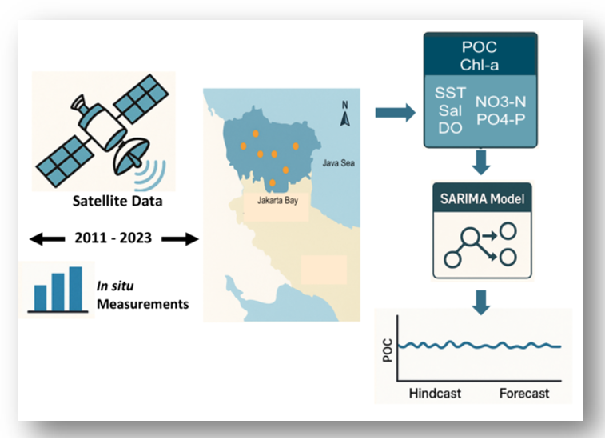
METHODS: Monthly moderate-resolution imaging spectroradiometer satellite data for surface particulate organic carbon and chlorophyll-a during 2011 to 2023 periods were collected. In addition, seasonal in-situ data of salinity, sea surface temperature, dissolved oxygen, nitrate, and phosphate, were also analysed to examine the potential role of natural processes as drivers of particulate organic carbon variability in this bay. The seasonal autoregressive integrated moving average model was selected for particulate organic carbon forecast.
FINDINGS: The concentration of particulate organic carbon varied between approximately 230 and 340 within the observed range. High concentrations were observed at the nearshore waters due to the discharge from the river to the bay. The seasonal variation indicates that the highest concentrations occur during the north west monsoon. Meanwhile, the lowest concentrations were observed during the Inter-monsoon II. Despite high variability, the trend in particulate organic carbon remains nearly flat (Coefficient of determination 0.0002) from hindcast to forecast.
CONCLUSION: The results showed that in Jakarta Bay, particulate organic carbon variability is primarily influenced by a combination of biological production and physical transport processes modulated by monsoonal forcing. The forecasting indicates minimal near-term change in particulate organic carbon dynamics along Jakarta's northern coast under current pressures.
Graphical Abstract
Highlights
- The POC concentrations of Jakarta Bay decrease seaward, with highest levels in nearshore waters;
- Seasonal variation of Jakarta Bay’s POC shows peak concentrations during the NW monsoon and minimum during Inter-monsoon II;
- POC variability in Jakarta Bay is driven by biological production and monsoon-modulated physical transport;
- Despite high variability, POC trends of Jakarta Bay remain flat, with forecasts indicating minimal near-term change under current conditions.
Keywords
Subjects
OPEN ACCESS
©2025 The author(s). This article is licensed under a Creative Commons Attribution 4.0 International License, which permits use, sharing, adaptation, distribution and reproduction in any medium or format, as long as you give appropriate credit to the original author(s) and the source, provide a link to the Creative Commons license, and indicate if changes were made. The images or other third party material in this article are included in the article’s Creative Commons license, unless indicated otherwise in a credit line to the material. If material is not included in the article’s Creative Commons license and your intended use is not permitted by statutory regulation or exceeds the permitted use, you will need to obtain permission directly from the copyright holder. To view a copy of this license, visit:
http://creativecommons.org/licenses/by/4.0/
PUBLISHER NOTE
GJESM Publisher remains neutral concerning jurisdictional claims in published maps and institutional affiliations.
MAJOR DATABASES, CITATION METRICS & CAPTURES
Google Scholar | Scopus - SJR | Web of Science | Biological Abstracts: Clarivate | Biosis Preview: Clarivate | PlumX Metrics | Altmetrics | Mendeley |
CURRENT PUBLISHER
GJESM Publisher




Letters to Editor
[1] Letters that include statements of statistics, facts, research, or theories should include appropriate references, although more than three are discouraged.
[2] Letters that are personal attacks on an author rather than thoughtful criticism of the author’s ideas will not be considered for publication.
[3] Letters can be no more than 300 words in length.
[4] Letter writers should include a statement at the beginning of the letter stating that it is being submitted either for publication or not.
[5] Anonymous letters will not be considered.
[6] Letter writers must include their city and state of residence or work.
[7] Letters will be edited for clarity and length.