Spatiotemporal analysis of rainfall variability using satellite precipitation in watersheds

Document Type : CASE STUDY

Authors

1 Research Center for Climate and Atmosphere, National Research and Innovation Agency, Serpong 15314, Indonesia

2 Research Center for Conservation of Marine and Inland Water Resources, National Research and Innovation Agency, Cibinong 16911, Indonesia

3 Research Center for Limnology and Water Resources, National Research and Innovation Agency, Serpong 15314, Indonesia

4 Research Center for Geological Disaster, National Research and Innovation Agency, Serpong 15314, Indonesia

Abstract
BACKGROUND AND OBJECTIVES: Understanding spatial and temporal rainfall variability is essential for effective water resource management in Indonesia, where diverse landscapes and dynamic tropical climates cause uneven precipitation that often leads to localized floods or droughts. This study aims to investigate how geomorphological and topographical differences across the Toba-Asahan, Brantas, and Larona-Malili watersheds in Indonesia influence rainfall distribution and trends, in order to support adaptive and sustainable watershed management.
METHODS: This study analyzes rainfall variability in three distinct Indonesian watersheds, Toba-Asahan, Brantas, and Larona-Malili, using climate hazards group infrared precipitation with Station version 2 satellite precipitation data. The spatial and temporal patterns of rainfall are examined in relation to each watershed’s unique geomorphological and topographical characteristics. Basic statistical analysis and mapping techniques are used to identify trends and visualize distribution patterns, aiming to provide insights into how natural landscape features influence rainfall behavior and water availability at the watershed scale.
FINDINGS: The results reveal a significant long-term increase in rainfall in the Larona-Malili watershed, while no statistically significant trends are observed in the Brantas and Toba-Asahan watersheds. The dominant rainfall patterns reflect the unique regional climatic characteristics of each watershed. Spectral analysis highlights the influence of El Niño Southern Oscillation and Indian Ocean Dipole, showing semi-annual rainfall patterns in Toba-Asahan and Larona-Malili, and an annual cycle in Brantas. Climatic sensitivity differs across the three watersheds, as reflected by the varying influence of the Webster-Yang Monsoon Index, El Niño Southern Oscillation, and Indian Ocean Dipole.
CONCLUSION: This study comprehensively analyzes rainfall variability in three significant watersheds in Indonesia; the Brantas, the Toba-Asahan, and the Larona-Malili watersheds. Another finding from this study is that seasonal rainfall patterns in the Brantas watershed is significantly influenced by the Asian Monsoon. In contrast, the Toba-Asahan and Larona-Malili watersheds are shaped by local and regional factors, with land use changes playing a role in rainfall variability and water resource impacts. Annual patterns vary among the watershed, with Toba-Asahan experiencing year-round rainfall peaking from August to December, Brantas dominated by afternoon convection-driven rain from January to April and November to December, and Larona-Malili showing morning-to-noon rainfall from May to July due to local circulation and topographic effects. The findings provide valuable insights into managing water resources and addressing climate change and extreme weather variability in Indonesia. In conclusion, the overall results of this study may serve as a basis for water resource management in the three watersheds, especially in the face of potential climate change and extreme weather variability.

Graphical Abstract

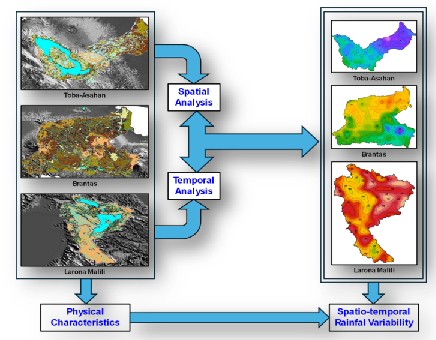
Spatiotemporal analysis of rainfall variability using satellite precipitation in watersheds

Highlights

  • A significant rainfall increase is found in the Larona-Malili watershed, while no considerable trends are detected in the Brantas and Toba-Asahan watersheds;
  • Climate phenomena (ENSO, DMI, WYMI) and land-use changes significantly influenced the rainfall variability and water resource dynamics in the watersheds;
  • The findings highlight the need for tailored water resource management strategies to address climate change and extreme weather variability in Indonesia.

Keywords

Subjects

OPEN ACCESS

©2025 The author(s). This article is licensed under a Creative Commons Attribution 4.0 International License, which permits use, sharing, adaptation, distribution and reproduction in any medium or format, as long as you give appropriate credit to the original author(s) and the source, provide a link to the Creative Commons license, and indicate if changes were made. The images or other third party material in this article are included in the article’s Creative Commons license, unless indicated otherwise in a credit line to the material. If material is not included in the article’s Creative Commons license and your intended use is not permitted by statutory regulation or exceeds the permitted use, you will need to obtain permission directly from the copyright holder. To view a copy of this license, visit: 

http://creativecommons.org/licenses/by/4.0/


PUBLISHER NOTE

GJESM Publisher remains neutral concerning jurisdictional claims in published maps and institutional affiliations.


MAJOR DATABASES, CITATION METRICS & CAPTURES

Google Scholar | Scopus - SJR | Web of Science | Biological Abstracts: Clarivate | Biosis Preview: Clarivate | PlumX Metrics | Altmetrics | Mendeley |


CURRENT PUBLISHER

GJESM Publisher

Letters to Editor

GJESM Journal welcomes letters to the editor for the post-publication discussions and corrections which allows debate post publication on its site, through the Letters to Editor. Letters pertaining to manuscript published in GJESM should be sent to the editorial office of GJESM within three months of either online publication or before printed publication, except for critiques of original research. Following points are to be considering before sending the letters (comments) to the editor.

[1] Letters that include statements of statistics, facts, research, or theories should include appropriate references, although more than three are discouraged.
[2] Letters that are personal attacks on an author rather than thoughtful criticism of the author’s ideas will not be considered for publication.
[3] Letters can be no more than 300 words in length.
[4] Letter writers should include a statement at the beginning of the letter stating that it is being submitted either for publication or not.
[5] Anonymous letters will not be considered.
[6] Letter writers must include their city and state of residence or work.
[7] Letters will be edited for clarity and length.

Send comment about this article
Enter Name.
Enter a valid email address.
Enter a vaid affiliation.
Enter comments (At leaset 10 words)
CAPTCHA Image
Enter Security Code Correctly.
Volume 11, Issue 3 - Serial Number 43
Summer 2025
Pages 1143-1162


Article Podcasts

  • Receive Date 28 January 2025
  • Revise Date 02 April 2025
  • Accept Date 05 May 2025