Document Type : RESEARCH ARTICLE
Authors
1
Research Center for Geological Disaster, National Research and Innovation Agency, Indonesia
2
Research Centre for Environmental and Clean Technology, National Research and Innovation Agency, Indonesia
3
Research Centre for Sustainable Production System and Life Cycle Assessment, National Research and Innovation Agency, Indonesia
4
Research Center for Mining Technology, National Research and Innovation Agency, Indonesia
5
Faculty of Geological Engineering, Universitas Padjadjaran, Indonesia
Abstract
BACKGROUND AND OBJECTIVES: Vegetation is essential for reducing shallow landslides by providing hydromechanical stability. However, effective slope stabilization requires understanding the spatial distribution of slip planes, a crucial aspect that remains underexplored in landslide mitigation studies. The study objectives were to develop a novel vegetation intervention model that integrates vegetation’s hydromechanical properties with slip plane distribution to enhance slope reinforcement and reduce landslide risk.
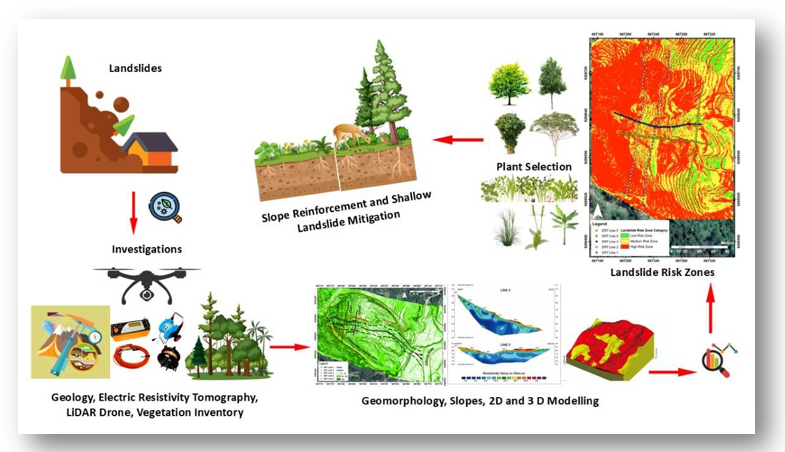
METHODS: Geological field investigations, electrical resistivity tomography, light detection and ranging drone surveys, geomorphological analysis, three-dimensional terrain modelling, and isopach map development combine vegetation’s hydromechanical effects. A vegetation inventory was conducted through field observations and interviews to assess pre- and post-landslide conditions. The landslide risks map was created by combining slope and lithology thickness above the slip plane using reclassification and weighting analyses. Vegetation interventions were then designed based on this map and the hydromechanical properties of selected plant species.
FINDINGS: The landslide area comprises brown breccia with moderate permeability and grey marl with slow permeability, exceeding 40 meters in thickness. The slip plane follows the breccia-marl contact, aligning with the slope dip, creating high landslide susceptibility. Slip plane depth varies with breccia thickness (0.5–4.5 meters). Pre-landslide vegetation, dominated by garden plants, bamboo, and selectively harvested woody species, had limited slope stabilization effects. The depletion and transition areas are divided into high, medium, and low landslide risk zones based on slopes and breccia thickness. Plants were selected based on root depth, evapotranspiration capacity, and canopy density properties.
CONCLUSION: In high-risk zones (breccia 3–4.5 meters, slopes >30 degrees), deep-rooted trees of >4.5 meters, fast-growing tree species with high evapotranspiration, and dense canopies such as Paraserianthes falcataria, Eucalyptus sp., and Acacia mangium, are recommended, with wider spacing to prevent additional loading. Bambussa sp. is also suitable due to its fibrous roots and high water absorption. Medium-risk zones (breccia 1–3 meters, slopes 10–30 degrees) benefit from species with >3 meters’ root depths, including Leucaena leucocephala, Artocarpus heterophyllus, Gmelina arborea, Mangifera indica, Swietenia sp., Bambussa sp., and Chrysopogon zizanoides. Low-risk zones (breccia <1 meter, slopes <10 degrees) can support shallow-rooted, economically valuable crops such as Cocos nucifera, Musa paradisiaca, Zea mays, Vigna unguiculata, Manihot esculenta, Capsicum annuum and Solanum lycopersicum. Cover crops can be integrated across all zones for stability and erosion control. This vegetation-based intervention provides a strategic model for slope reinforcement and shallow landslide mitigation.
Graphical Abstract
Highlights
- The Banar landslide is controlled by a permeable breccia layer (0.5–4.5 m) over slow-permeability grey marl (>40 m), with their contact as the slip plane;
- The alignment of the slip plane with the breccia-marl contact and slope dip increases landslide susceptibility, highlighting the importance of vegetation for slope stability;
- The landslide area is classified by breccia thickness and slope steepness, guiding vegetation strategies for high, moderate, and low-risk zones to enhance slope stability;
- A vegetation intervention model integrates fast-growing local and adaptive tropical species with varied root depths, evapotranspiration rates, canopy densities, and cover crops to improve slope stability and mitigate landslide risk.
Keywords
Subjects
OPEN ACCESS
©2025 The author(s). This article is licensed under a Creative Commons Attribution 4.0 International License, which permits use, sharing, adaptation, distribution and reproduction in any medium or format, as long as you give appropriate credit to the original author(s) and the source, provide a link to the Creative Commons license, and indicate if changes were made. The images or other third party material in this article are included in the article’s Creative Commons license, unless indicated otherwise in a credit line to the material. If material is not included in the article’s Creative Commons license and your intended use is not permitted by statutory regulation or exceeds the permitted use, you will need to obtain permission directly from the copyright holder. To view a copy of this license, visit:
http://creativecommons.org/licenses/by/4.0/
PUBLISHER NOTE
GJESM Publisher remains neutral concerning jurisdictional claims in published maps and institutional affiliations.
MAJOR DATABASES, CITATION METRICS & CAPTURES
Google Scholar | Scopus - SJR | Web of Science | Biological Abstracts: Clarivate | Biosis Preview: Clarivate | PlumX Metrics | Altmetrics | Mendeley |
CURRENT PUBLISHER
GJESM Publisher




Letters to Editor
[1] Letters that include statements of statistics, facts, research, or theories should include appropriate references, although more than three are discouraged.
[2] Letters that are personal attacks on an author rather than thoughtful criticism of the author’s ideas will not be considered for publication.
[3] Letters can be no more than 300 words in length.
[4] Letter writers should include a statement at the beginning of the letter stating that it is being submitted either for publication or not.
[5] Anonymous letters will not be considered.
[6] Letter writers must include their city and state of residence or work.
[7] Letters will be edited for clarity and length.