Document Type : RESEARCH ARTICLE
Authors
1
Industrial Engineering Department, College of Engineering and Architecture, Umm Al-Qura University, Mecca, Saudi Arabia
2
Department of Electrical Engineering, College of Engineering in Wadi Alddawasir, Prince Sattam bin Abdulaziz University, Wadi Alddawasir, Saudi Arabia
Abstract
BACKGROUND AND OBJECTIVES: Polymeric flocculants derived from the coagulation-flocculation procedure, such as chitosan, effectively remove algal-bacterial biomass from wastewater treatment, demonstrating efficiencies comparable to ferric salts at reduced dosages. The optimal operating condition of coagulation-flocculation in aquaculture wastewater treatment particularly requires defining accurate values of three input parameters: potential of hydrogen, chitosan dose, and settling time. Therefore, the objective of this study is determining the optimal operating condition of coagulation-flocculation through optimizing the values of the three input parameters.
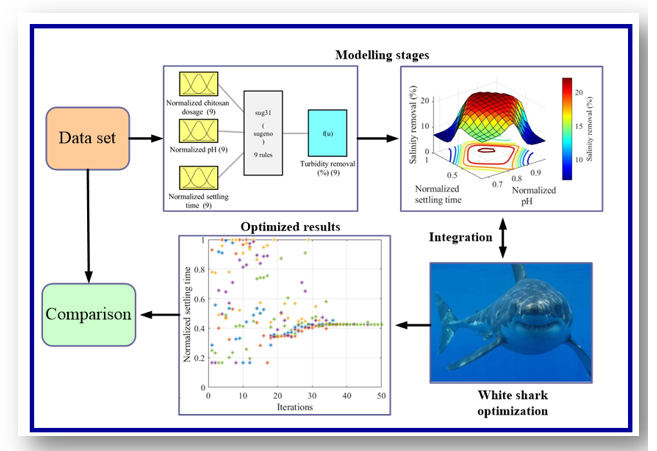
METHODS: Artificial intelligence and recent optimzation algorithms are integrated to achieve the purpose of this study work. Initially, an adaptive neuro-fuzzy inference system model of the wastewater treatment process was built based on experimental data. The white shark optimizer is then used to calculate the optimal chitosan dose, potential of hydrogen, and settling time for reducing turbidity and salinity. During the optimization process, these controlling parameters are used as a design variable whereas the objective function required to me be a maximum is the summation of turbidity removal and salinity removal.
FINDINGS: The adaptive neuro-fuzzy inference system turbidity removal model has root mean square error values of 3.52e-05 and 1.51 for training and testing data, respectively. The R-squared values for testing and training are 0.76 and 1.0, respectively. In compared to analysis of variance adaptive neuro-fuzzy inference system lowered the root mean square error from 2.8 to 0.836 (a 70 percent decrease). The estimated R-squared value rose by 11.76 percent, from 0.68 with analysis of variance to 0.76 with adaptive neuro-fuzzy inference system. The adaptive neuro-fuzzy inference system approach to salinity removal has root mean square error values of 7.13e-06 and 2.045 for training and testing. The R-squared values for training and testing are 1.0 and 0.82, respectively, and adaptive neuro-fuzzy inference system reduced the root mean square error from 6.8 with analysis of variance to 1.135 with adaptive neuro-fuzzy inference system achieving an 83.5 percent reduction. The R-squared value for prediction rose 7.2 percent from 0.765 via analysis of variance to 0.82 via adaptive neuro-fuzzy inference system.
CONCLUSION: Adaptive neuro-fuzzy inference system succseded to present an accurate model of wastewater treatment process and white shark optimizer defined accutrelly the values of chitosan dose, pontential of hydrogen, and settling time to reduce turbidity and salinity. Accordingly, optimizing chitosan-based coagulation-flocculation offers significant environmental benefits by reducing toxic chemical usage and minimizing sludge generation, leading to less pollution.
Graphical Abstract
Highlights
- ANFIS reduced the root mean square error from 6.8 with analysis of variance to 1.135 with ANFIS achieving an 83.5 percent reduction;
- The R-squared value for prediction rose 7.2 percent from 0.765 via analysis of variance to 0.82 via adaptive neuro-fuzzy inference system.
- For first time, white shark optimization is applied to define the best values of chitosan dose, pH, and settling time;
- Integrating ANFIS and WSO increased the total performance index by 6.55% and 4.6% compared measured data and ANOVA.
Keywords
Subjects
OPEN ACCESS
©2025 The author(s). This article is licensed under a Creative Commons Attribution 4.0 International License, which permits use, sharing, adaptation, distribution and reproduction in any medium or format, as long as you give appropriate credit to the original author(s) and the source, provide a link to the Creative Commons license, and indicate if changes were made. The images or other third party material in this article are included in the article’s Creative Commons license, unless indicated otherwise in a credit line to the material. If material is not included in the article’s Creative Commons license and your intended use is not permitted by statutory regulation or exceeds the permitted use, you will need to obtain permission directly from the copyright holder. To view a copy of this license, visit:
http://creativecommons.org/licenses/by/4.0/
PUBLISHER NOTE
GJESM Publisher remains neutral concerning jurisdictional claims in published maps and institutional affiliations.
MAJOR DATABASES, CITATION METRICS & CAPTURES
Google Scholar | Scopus - SJR | Web of Science | Biological Abstracts: Clarivate | Biosis Preview: Clarivate | PlumX Metrics | Altmetrics | Mendeley |
CURRENT PUBLISHER
GJESM Publisher




Letters to Editor
[1] Letters that include statements of statistics, facts, research, or theories should include appropriate references, although more than three are discouraged.
[2] Letters that are personal attacks on an author rather than thoughtful criticism of the author’s ideas will not be considered for publication.
[3] Letters can be no more than 300 words in length.
[4] Letter writers should include a statement at the beginning of the letter stating that it is being submitted either for publication or not.
[5] Anonymous letters will not be considered.
[6] Letter writers must include their city and state of residence or work.
[7] Letters will be edited for clarity and length.