Balancing environmental quality and economic profitability for sustainable rice-soybean cropping system

Document Type : RESEARCH ARTICLE

Authors

1 Biology Education Program, Faculty of Education, Chiang Rai Rajabhat University, Chiang Rai, Thailand

2 Mathematics Education Program, Faculty of Education, Chiang Rai Rajabhat University, Chiang Rai, Thailand

Abstract
BACKGROUND AND OBJECTIVES: The rice-soybean cropping system plays a significant role in the agricultural landscape of northern Thailand, providing crucial food and income sources for farmers. A major challenge persists in reconciling the economic gains provided by these systems with their environmental effects. This study analyzed the compromises between economic outcomes and environmental impacts within rice-soybean cropping systems in northern Thailand. The objective was to identify farming practices that balance profit maximization with environmental impact reduction.
METHODS: Data on the cropping system were collected from rice farmers in Chiang Rai province, located in the northernmost part of Thailand during the 2023 cropping year covering nine farms across nine different districts. The environmental impacts were quantified using life cycle assessment, while multi-objective linear programming was implemented to  to identify optimal agricultural practices. The analysis assessed baseline environmental performance and explored scenarios aimed at minimizing global warming potential and human toxicity potential and/or maximizing profitability.
FINDINGSAccording to the baseline analysis, rice cultivation was found to have a major environmental impact, largely attributed to fertilizer usage and emissions from the fields. In contrast, soybean cultivation demonstrated a lower environmental footprint, primarily influenced by fuel consumption and herbicide application. Profit-maximizing practices yielded the highest net profit but were associated with the greatest environmental impacts. In contrast, scenarios minimizing global warming potential and human toxicity potential achieved reduced environmental harm but at the expense of profitability. The eco-optimal farming model provided a harmonious solution, reaching close to peak profits while simultaneously minimizing environmental impacts to a reasonable extent.
CONCLUSION: The eco-optimal farming model highlighted the trade-offs involved in optimizing these two objectives. The profit-maximizing scenario achieved the highest net profit but led to increased environmental impacts, while scenarios focused on minimizing the environmental impacts resulted in decreased profitability. The eco-optimal farming strategy presented a harmonious balance, reaching close to peak profits while simultaneously lessening environmental impacts to a reasonable extent. These findings underscored the potential of integrating sustainable practices into the rice-soybean cropping system to enhance both economic and environmental outcomes.

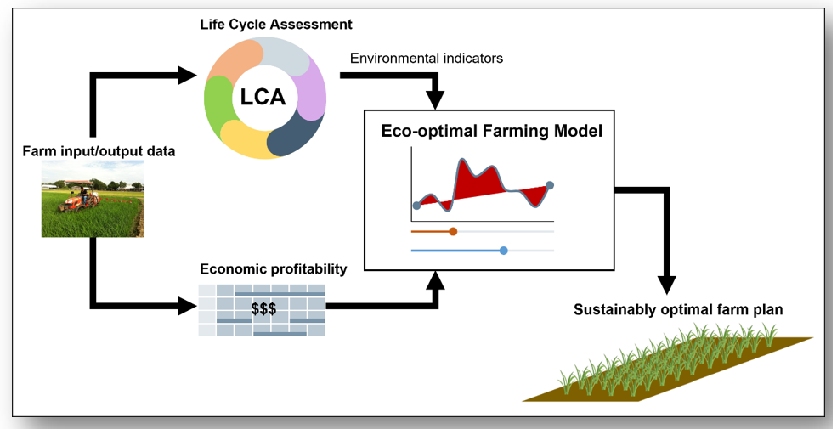
Graphical Abstract

Balancing environmental quality and economic profitability for sustainable rice-soybean cropping system

Highlights

  • A novel eco-optimal farming model integrating life cycle assessment and multi-objective Linear Programming has been developed to optimize rice-soybean cropping systems in northern Thailand;
  • In the rice-soybean cropping system, rice contributes significantly to global warming and toxicity, while soybean has lower impacts, with herbicide use as a notable factor;
  • The model identified critical trade-offs between profit maximization and environmental impact reduction, focusing on global warming potential and human toxicity potential;
  • Eco-optimal farming of the cropping system can be achieved by growing soybean after rice to reduce chemical fertilizer inputs, replacing high-toxicity pesticides with environmentally friendlier alternatives, and incorporating other sustainable practices.

Keywords

Subjects

OPEN ACCESS

©2025 The author(s). This article is licensed under a Creative Commons Attribution 4.0 International License, which permits use, sharing, adaptation, distribution and reproduction in any medium or format, as long as you give appropriate credit to the original author(s) and the source, provide a link to the Creative Commons license, and indicate if changes were made. The images or other third party material in this article are included in the article’s Creative Commons license, unless indicated otherwise in a credit line to the material. If material is not included in the article’s Creative Commons license and your intended use is not permitted by statutory regulation or exceeds the permitted use, you will need to obtain permission directly from the copyright holder. To view a copy of this license, visit: 

http://creativecommons.org/licenses/by/4.0/


PUBLISHER NOTE

GJESM Publisher remains neutral concerning jurisdictional claims in published maps and institutional affiliations.


CITATION METRICS & CAPTURES

Google Scholar | Scopus | Web of Science | PlumX Metrics | Altmetrics | Mendeley |


CURRENT PUBLISHER

GJESM Publisher

Letters to Editor

GJESM Journal welcomes letters to the editor for the post-publication discussions and corrections which allows debate post publication on its site, through the Letters to Editor. Letters pertaining to manuscript published in GJESM should be sent to the editorial office of GJESM within three months of either online publication or before printed publication, except for critiques of original research. Following points are to be considering before sending the letters (comments) to the editor.

[1] Letters that include statements of statistics, facts, research, or theories should include appropriate references, although more than three are discouraged.
[2] Letters that are personal attacks on an author rather than thoughtful criticism of the author’s ideas will not be considered for publication.
[3] Letters can be no more than 300 words in length.
[4] Letter writers should include a statement at the beginning of the letter stating that it is being submitted either for publication or not.
[5] Anonymous letters will not be considered.
[6] Letter writers must include their city and state of residence or work.
[7] Letters will be edited for clarity and length.

Send comment about this article
Enter Name.
Enter a valid email address.
Enter a vaid affiliation.
Enter comments (At leaset 10 words)
CAPTCHA Image
Enter Security Code Correctly.

Article Podcasts

  • Receive Date 20 October 2024
  • Revise Date 25 December 2024
  • Accept Date 27 January 2025