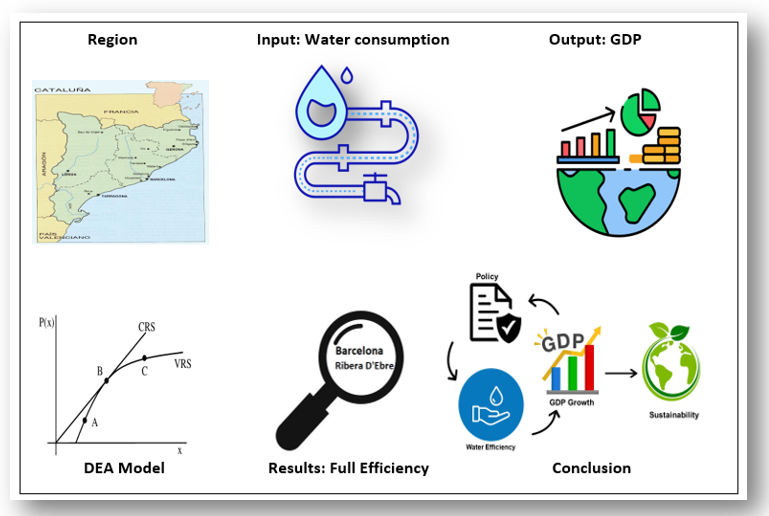
BACKGROUND AND OBJECTIVES: Water resources are essential for socio-economic development and quality of life, but limited availability, especially in regions with uneven distribution, poses challenges. Catalonia, due to fast-paced economic development, is under immense pressure from water scarcity issues, highlighting the need for efficient resource management. The objectives of the current study were to evaluate the existing water resource consumption efficiency in key sectors across Catalonia and suggest workable strategies for water management to ensure sustainability. METHODS: The water resource consumption efficiency of 42 Catalan regions in 2021 was analyzed using 50 data envelopment analysis models, employing both constant and variable returns to scale. Gross domestic product and water consumption information was acquired from regional governmental sources. The analysis included input and output-oriented models to identify opportunities for efficiency improvement. FINDINGS: The results showed that Barcelona’s industrial sector achieved optimal water resource consumption efficiency with a score of 1 in both models, setting a benchmark. Ribera d’Ebre reached full efficiency in domestic water consumption with a score of 1. Conversely, regions such as Priorat, Terra Alta, and Barcelona showed inefficiencies, suggesting that to achieve full efficiency, Priorat, Terra Alta, and Barcelona could reduce inputs by approximately 63 percent, 44 percent, and 26 percent, respectively, or increase outputs by approximately 172 percent, 78 percent, and 36 percent respectively, holding other factors constant. CONCLUSION: Targeted efficiency improvements in lower-scoring regions can contribute significantly to sustainable water management in Catalonia. Adopting successful practices observed in benchmark regions could enhance water resource management, supporting economic resilience and environmental sustainability.
Graphical Abstract
Highlights
Barcelona and Ribera d’Ebre exhibit full efficiency in both CRS and VRS models, setting a standard for sustainable water consumption management and economic output optimization;
Regions like Priorat and Terra Alta achieve full VRS efficiency but exhibit inefficiencies in CRS, emphasizing the need for strategic scaling to bridge resource allocation gaps;
Analyzing lambda values reveals pathways for improving resource utilization and aligning other regions with the efficiency frontier established by leading units;
Approximately 65% of the regions indicate potential for efficiency gains, underscoring the importance of targeted management reforms, infrastructure investment, and strategic cooperation to enhance water-use efficiency and sustainability.
GJESM Journal welcomes letters to the editor for the post-publication discussions and corrections which allows debate post publication on its site, through the Letters to Editor. Letters pertaining to manuscript published in GJESM should be sent to the editorial office of GJESM within three months of either online publication or before printed publication, except for critiques of original research. Following points are to be considering before sending the letters (comments) to the editor.
[1] Letters that include statements of statistics, facts, research, or theories should include appropriate references, although more than three are discouraged.
[2] Letters that are personal attacks on an author rather than thoughtful criticism of the author’s ideas will not be considered for publication.
[3] Letters can be no more than 300 words in length.
[4] Letter writers should include a statement at the beginning of the letter stating that it is being submitted either for publication or not.
[5] Anonymous letters will not be considered.
[6] Letter writers must include their city and state of residence or work.
[7] Letters will be edited for clarity and length.
Bayat, Z., Vives Costa, J. & de Felipe Blanch, J. (2025). Optimizing industrial and domestic water consumption efficiency for sustainable growth through data envelopment analysis. Global Journal of Environmental Science and Management, 11(2), 481–496. https://doi.org/10.22034/gjesm.2025.02.07
MLA
Bayat, Z., Vives Costa, J., & de Felipe Blanch, J. "Optimizing industrial and domestic water consumption efficiency for sustainable growth through data envelopment analysis", Global Journal of Environmental Science and Management, 11, 2, 2025, 481–496. doi: 10.22034/gjesm.2025.02.07
HARVARD
Bayat, Z., Vives Costa, J., & de Felipe Blanch, J. (2025). 'Optimizing industrial and domestic water consumption efficiency for sustainable growth through data envelopment analysis', Global Journal of Environmental Science and Management, 11(2), pp. 481–496. doi: 10.22034/gjesm.2025.02.07
CHICAGO
Bayat, Z., Vives Costa, J. & de Felipe Blanch, J., "Optimizing industrial and domestic water consumption efficiency for sustainable growth through data envelopment analysis." Global Journal of Environmental Science and Management, 11 2 (2025): 481–496, doi: 10.22034/gjesm.2025.02.07
VANCOUVER
Bayat Z., Vives Costa J., de Felipe Blanch J. Optimizing industrial and domestic water consumption efficiency for sustainable growth through data envelopment analysis. Global J. Environ. Sci. Manage. 2025;11(2):481–496. doi: 10.22034/gjesm.2025.02.07
Letters to Editor
[1] Letters that include statements of statistics, facts, research, or theories should include appropriate references, although more than three are discouraged.
[2] Letters that are personal attacks on an author rather than thoughtful criticism of the author’s ideas will not be considered for publication.
[3] Letters can be no more than 300 words in length.
[4] Letter writers should include a statement at the beginning of the letter stating that it is being submitted either for publication or not.
[5] Anonymous letters will not be considered.
[6] Letter writers must include their city and state of residence or work.
[7] Letters will be edited for clarity and length.