Document Type : CASE STUDY
Authors
1
Center of Excellence for Mangrove, Universitas Sumatera Utara, Medan, 20155, Indonesia
2
Department of Forestry, Faculty of Forestry, Universitas Sumatera Utara, Medan, 20155, Indonesia
3
Research Center for Ecology and Ethnobiology, National Research and Innovation Agency, Jl. Raya Jakarta-Bogor, Cibinong, West Java, 16911, Indonesia
4
Doctoral Program of Agricultural Sciences, Faculty of Agriculture, Universitas Sumatera, Medan, 20155, Indonesia
5
Research Center for Biosystematics and Evolution, National Research and Innovation Agency, Jl. Raya Jakarta-Bogor, Cibinong, West Java, 16911, Indonesia
6
Research Center for Applied Botany, National Research and Innovation Agency, Jl. Raya Jakarta-Bogor, Cibinong, West Java, 16911, Indonesia
7
Department of Silviculture, Faculty of Forestry and Environment, IPB University, Ulin Street, IPB Dramaga Campus, Bogor, West Java, 16680, Indonesia
8
Department of Chemistry, Universitas Negeri Medan, Jl. Willem Iskandar, Pasar V, Medan Estate, Medan, 20221 Indonesia
Abstract
BACKGROUND AND OBJECTIVES: The ongoing destruction of mangrove forests highlights the urgent need for mitigation and control efforts. Indonesia, home to a rich diversity of mangrove species, has the potential to provide viable solutions to address this issue. Researchers primarily focus on preserving the existence of each species. It is crucial that research data support control and mitigation strategies to ensure efficient and optimal management of these ecosystems. Understanding a species’ resilience to changes in land use can provide valuable insights into its adaptability. This adaptability can be evaluated by examining changes in leaf morphology and anatomy. This study investigated the morphological and anatomical characteristics of three species in the Rhizophoraceae family: Rhizophora mucronata, Rhizophora apiculata, and Rhizophora stylosa, which thrive in three distinct mangrove ecosystems in North Sumatra Province. The objective was to evaluate how well these species have adapted to changes in their environmental conditions. The objectives of the current study were to determine how well these species adapted to changing habitat environmental conditions in North Sumatra Province, Indonesia.
METHODS: This study involved selecting locations that represented three distinct land uses: residential areas in Belawan Sub-District, healthy mangrove forests in Sitardas Village, and mangrove areas utilized as fish ponds in Percut Sei Tuan Sub-District. Observations were made on three mangrove species: Rhizophora apiculata Blume, Rhizophora mucronata Poir, and Rhizophora stylosa Griff, to assess how their leaf morphology and anatomy respond to changes in land use within their natural environments. Leaf samples were collected from three different locations, with ten trees of each species at each location. Each tree had five branches, and from each branch, five healthy leaves were selected for measurement and analysis. Data were gathered on 12 distinct characters. The preparation of leaf material for observing stomatal characteristics utilized the stomatal printing method. Data were collected on seven characteristics. Stomatal density and stomatal index were measured across 15 units per leaf. The morphological and anatomical characteristics of Rhizophora apiculata, Rhizophora mucronata, and Rhizophora stylosa were statistically analyzed using Analysis of Variance. Additionally, the environmental parameters were illustrated in a principal component analysis graphic to highlight variations among the sampling sites.
FINDINGS: The results revealed that the varying land use conditions at each study site affected the three species of Rhizophora. Rhizophora stylosa was unable to grow at the Medan Belawan study site due to severe damage and pollution. In contrast, the other two sites, Percut Sei Tuan and Sitardas, are lightly polluted environments that are suitable for all three Rhizophora species. This finding demonstrates that certain Rhizophora species, specifically Rhizophora apiculata and Rhizophora mucronata, can thrive in habitat conditions and environmental factors that are unsuitable for Rhizophora stylosa. Additionally, all three Rhizophora species exhibited significant differences in the stomatal index. Rhizophora apiculata had a stomatal index of 19.69, Rhizophora mucronata had a value of 111.7, and Rhizophora stylosa had a value of 24.67. These variations may impact their efficiency in adapting to their respective environments.
CONCLUSION: This study offers insight into how three Rhizophora species adapt to changes in land use. Each species demonstrates distinct adaptations influenced by various factors. The findings of this study will be valuable for recommending species that are suitable for restoration activities in mangrove ecosystems.
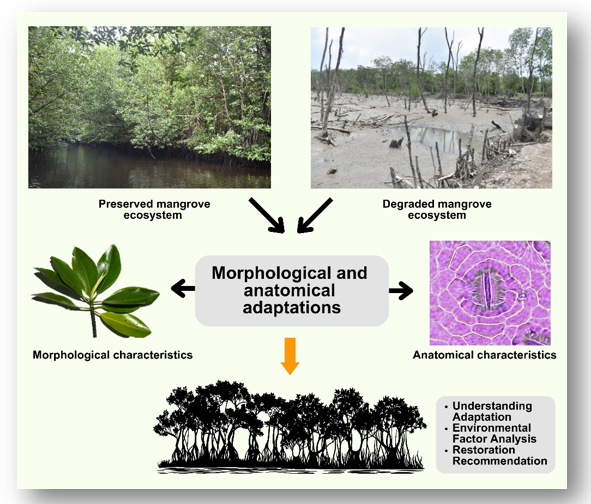
Graphical Abstract
Highlights
- R. mucronata adapts best to land-use changes, with significant effects on lamina length (F = 45.43) and petiole length (F = 13.64);
- R. apiculata exhibits high sensitivity to environmental variation, with stomatal index (F = 19.69) and stomatal width (F = 37.84) strongly affected;
- High salinity in Percut Sei Tuan (33.06 ppm) reduces leaf width and increases stomatal density, optimizing transpiration and gas exchange in mangrove species;
- PCA highlights distinct environmental profiles, with salinity and pollution as key drivers affecting species distribution and adaptability.
Keywords
Subjects
OPEN ACCESS
©2025 The author(s). This article is licensed under a Creative Commons Attribution 4.0 International License, which permits use, sharing, adaptation, distribution and reproduction in any medium or format, as long as you give appropriate credit to the original author(s) and the source, provide a link to the Creative Commons license, and indicate if changes were made. The images or other third party material in this article are included in the article’s Creative Commons license, unless indicated otherwise in a credit line to the material. If material is not included in the article’s Creative Commons license and your intended use is not permitted by statutory regulation or exceeds the permitted use, you will need to obtain permission directly from the copyright holder. To view a copy of this license, visit:
http://creativecommons.org/licenses/by/4.0/
PUBLISHER NOTE
GJESM Publisher remains neutral concerning jurisdictional claims in published maps and institutional affiliations.
CITATION METRICS & CAPTURES
Google Scholar | Scopus | Web of Science | PlumX Metrics | Altmetrics | Mendeley |
CURRENT PUBLISHER
GJESM Publisher




Letters to Editor
[1] Letters that include statements of statistics, facts, research, or theories should include appropriate references, although more than three are discouraged.
[2] Letters that are personal attacks on an author rather than thoughtful criticism of the author’s ideas will not be considered for publication.
[3] Letters can be no more than 300 words in length.
[4] Letter writers should include a statement at the beginning of the letter stating that it is being submitted either for publication or not.
[5] Anonymous letters will not be considered.
[6] Letter writers must include their city and state of residence or work.
[7] Letters will be edited for clarity and length.