Modeling the effects of land use change on agricultural carrying capacity and food security

Document Type : RESEARCH ARTICLE

Authors

1 Department of Environmental Geography, Faculty of Geography, Universitas Gadjah Mada, Yogyakarta, Indonesia

2 Department of Development Geography, Faculty of Geography, Universitas Gadjah Mada, Yogyakarta, Indonesia

3 Department of Geography, Faculty of Mathematics and Natural Sciences, Universitas Negeri Makassar, Makassar, Indonesia

Abstract
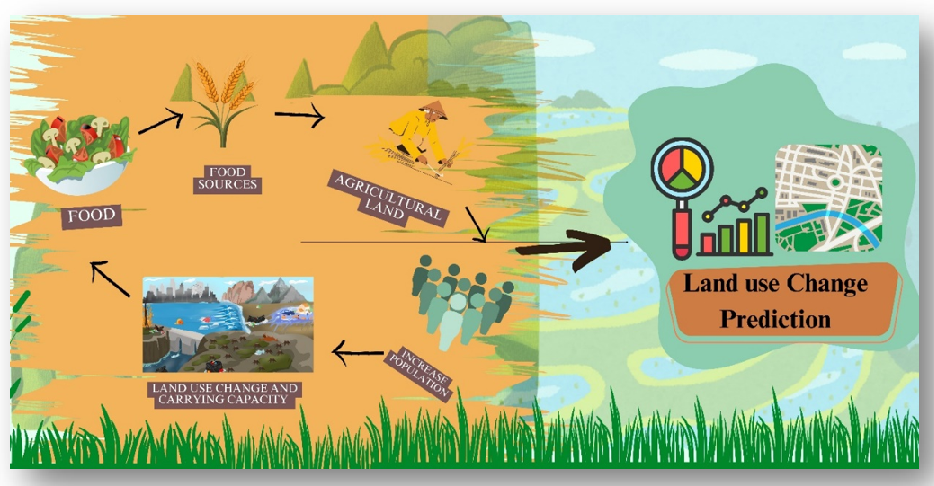
BACKGROUND AND OBJECTIVES: Food security is a global issue outlined in the sustainable development goals. Food problems are related to the availability of food sources. The availability of agricultural land as the primary source of food production is decreasing due to the increase in population. Changing agricultural land to built-up land causes problems in food security and the land’s carrying capacity.  This study aims to detect land use changes and performs simulations models to predict future land use changes in the special region of Yogyakarta and their impact on the region’s agricultural land carrying capacity and food security. Predictions of spatial land changes will reveal changes in land function, carrying capacity and food security between regions.
METHODS: Land changes were studied using remote sensing imagery-based mapping methods and spatial simulations using the cellular automata approach. The land change map illustrates the spatial distribution of agricultural land that has changed.Spatial simulation was carried out using the cellular automata algorithm, through computers and spatial data processing software. The carrying capacity of agricultural land is used to calculate the availability of rice fields to support the food needs of the population. Determination of the land carrying capacity status is carried out by comparing land availability with land needs. Meanwhile, the calculation of food security uses a methodology adopted from the food security and vulnerability atlas method.
RESULTS: Prediction results showed that the special region of Yogyakarta’s built-up land area will expand between 2026 and 2034. The land carrying capacity will decline with the expansion of the built-up area, which will primarily be converted from agricultural land. However, the agricultural land’s carrying capacity increased, and the food security decreased. Through the preservation of agricultural land and the use of agricultural advances, the agricultural land’s carrying capacity can be increased to support sustainable food security. The carrying capacity of the agricultural land in the special region of Yogyakarta between 2018 and 2022 ranged from 0.0026 to 1.034. In 2018, most areas in this region had high food security. Yogyakarta City was the only city in 2018 with the lowest food security at 66.34. In 2022, Kulon Progo Regency and Sleman Regency had a lower food security level than the previous year.
CONCLUSION: This study explores land use change, land carrying capacity, and food security in the Special Region of Yogyakarta, Indonesia. Land conversion is inevitable due to population growth and development programs, and the rise of agricultural areas turning into built-up land threatens food sources. The study uses food security and vulnarebility atlas mapping indicators, agricultural land carrying capacity, and food security to explain the complex interactions. Cellular automata predicts land use changes, showing the highest land use change in 2034 directly impacts land carrying capacity and food security. Proactive approaches are needed to ensure food security and sustainable agricultural development. The findings can guide future research and policy efforts to improve food security and encourage sustainable agricultural practices.

Graphical Abstract

Modeling the effects of land use change on agricultural carrying capacity and food security

Highlights

  • Changes in agricultural land in the research area are decreasing, affecting the carrying capacity of the land and also food security for the community. The population of the community in the research location is increasing, which must be accompanied by the stability of food security;
  • This study combines macro aspects regionally and micro aspects at the household level. Combining land change prediction models with agricultural land carrying capacity. Comparison between regions on food security in terms of physical and socio-economic aspects;
  • The study highlights how changes in agricultural land use significantly influence carrying capacity, which impacts food security. Regions with diverse agricultural production, such as Kulon Progo Regency, can achieve surplus-carrying capacities through effective agricultural development strategies.

Keywords

Subjects

OPEN ACCESS

©2025 The author(s). This article is licensed under a Creative Commons Attribution 4.0 International License, which permits use, sharing, adaptation, distribution and reproduction in any medium or format, as long as you give appropriate credit to the original author(s) and the source, provide a link to the Creative Commons license, and indicate if changes were made. The images or other third party material in this article are included in the article’s Creative Commons license, unless indicated otherwise in a credit line to the material. If material is not included in the article’s Creative Commons license and your intended use is not permitted by statutory regulation or exceeds the permitted use, you will need to obtain permission directly from the copyright holder. To view a copy of this license, visit: 

http://creativecommons.org/licenses/by/4.0/


PUBLISHER NOTE

GJESM Publisher remains neutral concerning jurisdictional claims in published maps and institutional affiliations.


CITATION METRICS & CAPTURES

Google Scholar | Scopus | Web of Science | PlumX Metrics | Altmetrics | Mendeley |


CURRENT PUBLISHER

GJESM Publisher

Letters to Editor

GJESM Journal welcomes letters to the editor for the post-publication discussions and corrections which allows debate post publication on its site, through the Letters to Editor. Letters pertaining to manuscript published in GJESM should be sent to the editorial office of GJESM within three months of either online publication or before printed publication, except for critiques of original research. Following points are to be considering before sending the letters (comments) to the editor.

[1] Letters that include statements of statistics, facts, research, or theories should include appropriate references, although more than three are discouraged.
[2] Letters that are personal attacks on an author rather than thoughtful criticism of the author’s ideas will not be considered for publication.
[3] Letters can be no more than 300 words in length.
[4] Letter writers should include a statement at the beginning of the letter stating that it is being submitted either for publication or not.
[5] Anonymous letters will not be considered.
[6] Letter writers must include their city and state of residence or work.
[7] Letters will be edited for clarity and length.

Send comment about this article
Enter Name.
Enter a valid email address.
Enter a vaid affiliation.
Enter comments (At leaset 10 words)
CAPTCHA Image
Enter Security Code Correctly.

Article Podcasts

  • Receive Date 29 September 2024
  • Revise Date 04 December 2024
  • Accept Date 07 January 2025