Urban heat island classification through alternative normalized difference vegetation index

Document Type : RESEARCH ARTICLE

Authors

1 Department of Mechanical Engineering, Chiang Mai University, Thailand

2 Department of Civil Engineering, Chiang Mai University, Thailand

Abstract
BACKGROUND AND OBJECTIVES: Urban heat island is characterized by higher temperatures in urban areas compared to their surroundings. Vegetation, quantified by the normalized difference vegetation index, is key in mitigating urban heat island effects and influencing land surface temperature. With the rise of Machine Learning techniques, particularly random forest, land surface temperature predictions have become more accurate. This study explores alternative normalized difference vegetation index adjustments to understand their impact on urban heat island classification in Chiang Mai, Thailand. It investigates how changes to the normalized difference vegetation index can help to be part of practical urban planning measures, such as prioritizing vegetation type and location for cooling strategies in urban areas. Furthermore, the study aims to highlight the importance of vegetation as a sustainable solution for mitigating the adverse effects of urban heat island and enhancing urban livability.
METHODS: Satellite data from Sentinel-2 and Landsat 8 for 2016–2022 were used to develop a 20-meters grid resolution dataset, resulting in approximately 2 million points. Random Forest was employed to predict land surface temperature, followed by systematically adjusting normalized difference vegetation index values from -100 percent to +100 percent in 10 percent increments. Urban heat island was classified based on standard deviation thresholds. The results were analyzed and compared visually using geographic information system, incorporating spatial variations and heat intensity patterns to better understand the urban landscape.
FINDINGS: Adjusting normalized difference vegetation index values showed a nonlinear relationship with Land Surface Temperature predictions, where certain thresholds caused unexpected decreases in Land Surface Temperature. Urban heat island classifications identified distinct urban regions with varying heat intensities. The visual comparison highlighted significant differences between the base case and alternative scenarios, revealing the sensitivity of land surface temperature to vegetation density. the results also emphasized the role of high normalized difference vegetation index values in cooling urban regions and reducing urban heat island intensity, while extreme reductions in vegetation led to potential misclassification of water bodies, creating anomalies in cooling patterns. The results of this research provide information on important variables that affect the changes in the urban heat islands, focusing on changes in vegetation, which can be a part of decision-making to improve urban planning in the future.
CONCLUSION: The study demonstrates the influence of normalized difference vegetation index on urban heat island classification and its potential in urban planning strategies. By highlighting nonlinear trends, the research underscores further the need to explore vegetation dynamics in land surface temperature predictions. The findings contribute to a deeper understanding of urban heat island effects and provide a basis for enhancing machine Learning models and urban planning frameworks. Future studies could expand to other urban areas, incorporate additional variables, and refine predictive algorithms for broader applications. This study will serve as a foundation for the development of future real-time monitoring tools that will enable proactive and sustainable solutions to UHI problems. 

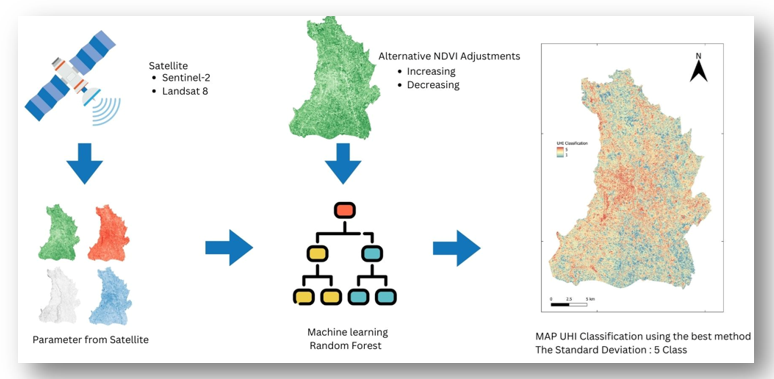
Graphical Abstract

Urban heat island classification through alternative normalized difference vegetation index

Highlights

  • Adjustments in NDVI reveal a nonlinear relationship with LST, emphasizing the complex role of vegetation in UHI mitigation;
  • NDVI increments consistently reduce UHI intensity, while extreme decrements unexpectedly lower LST due to misclassification as water bodies;
  • Random Forest effectively predicts LST, capturing spatial and temporal patterns critical for UHI classification;
  • UHI classifications identify central urban heat hotspots, supporting targeted urban planning strategies for sustainable cooling solutions.

Keywords

Subjects

OPEN ACCESS

©2025 The author(s). This article is licensed under a Creative Commons Attribution 4.0 International License, which permits use, sharing, adaptation, distribution and reproduction in any medium or format, as long as you give appropriate credit to the original author(s) and the source, provide a link to the Creative Commons license, and indicate if changes were made. The images or other third party material in this article are included in the article’s Creative Commons license, unless indicated otherwise in a credit line to the material. If material is not included in the article’s Creative Commons license and your intended use is not permitted by statutory regulation or exceeds the permitted use, you will need to obtain permission directly from the copyright holder. To view a copy of this license, visit: 

http://creativecommons.org/licenses/by/4.0/


PUBLISHER NOTE

GJESM Publisher remains neutral concerning jurisdictional claims in published maps and institutional affiliations.


CITATION METRICS & CAPTURES

Google Scholar | Scopus | Web of Science | PlumX Metrics | Altmetrics | Mendeley |


CURRENT PUBLISHER

GJESM Publisher

Letters to Editor

GJESM Journal welcomes letters to the editor for the post-publication discussions and corrections which allows debate post publication on its site, through the Letters to Editor. Letters pertaining to manuscript published in GJESM should be sent to the editorial office of GJESM within three months of either online publication or before printed publication, except for critiques of original research. Following points are to be considering before sending the letters (comments) to the editor.

[1] Letters that include statements of statistics, facts, research, or theories should include appropriate references, although more than three are discouraged.
[2] Letters that are personal attacks on an author rather than thoughtful criticism of the author’s ideas will not be considered for publication.
[3] Letters can be no more than 300 words in length.
[4] Letter writers should include a statement at the beginning of the letter stating that it is being submitted either for publication or not.
[5] Anonymous letters will not be considered.
[6] Letter writers must include their city and state of residence or work.
[7] Letters will be edited for clarity and length.

Send comment about this article
Enter Name.
Enter a valid email address.
Enter a vaid affiliation.
Enter comments (At leaset 10 words)
CAPTCHA Image
Enter Security Code Correctly.

Article Podcasts

  • Receive Date 26 August 2024
  • Revise Date 01 November 2024
  • Accept Date 05 December 2024