Potential application of rain water harvesting technology as an alternative clean water source to mitigate land subsidence

Document Type : CASE STUDY

Authors

School of Environmental Science, Universitas Indonesia, Kampus UI Salemba, Jl. Salemba Raya, Central Jakarta City, Jakarta 10430, Indonesia

Abstract
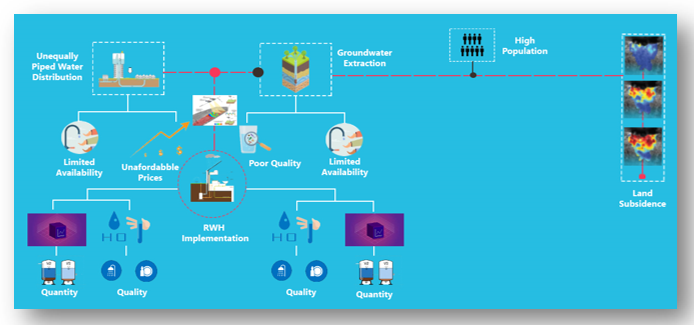
BACKGROUND AND OBJECTIVES: The limited supply of tap water has implications for the massive usage of groundwater in North Jakarta's coastal area, that suffer crucial land subsidence. As a result, it is critical to provide alternate sources of sustainable clean water that can minimize groundwater consumption. Based on climatological aspect, rainwater harvesting technology has potential and has been applied in several unplanned dense residential areas, around the coast. According to that, this study aims to analyze the contribution of rainwater harvesting technology implementation in terms of supply and utilization aspects to reducing groundwater use and meeting clean water needs for mitigating land subsidence in the coastal area of North Jakarta
METHODS: This study was conducted in North Jakarta coastal area within a radius of 0—2 kilometers, by conducting survey activities on 148 households who live near the location of the technology installation, as well as collecting the depth wells data, and clean water samples. The survey activity is intended to supporting regression analysis and crosstabulation, regarding the contribution of using Rain Water Harvesting technology in mitigating land subsidence.
FINDINGS: Based on its quality, rainwater harvesting has the potential to support the fulfillment of clean water needs in North Jakarta, especially for sanitation purposes. The findings of quality test also explain in more depth that clean water from the rainwater harvesting system was safer for consumption than groundwater, both from dug and drilled wells. The groundwater samples tested showed extremely high levels of Total Dissolved Solids (2829 mlligrams per liter), making it extremely dangerous to use for cooking and drinking, as well as sanitation, such as bathing and washing. In terms of quantity, mathematical calculations estimate that the provision of rainwater harvesting installations can support 0.2 percent of clean water for sanitation purposes in each implementation area. The finding indicates that the belief that rainwater harvesting can effectively meet water needs is a key driver in the decision to utilize rainwater harvesting.
CONCLUSION: The expanding rainwater harvesting is very related to the mitigating the land subsidence, through the decreasing depending on extracting groundwater as their source of wáter supply. The difficulty of  satisfying clean water needs due to these various factors was the reason why respondents chose to utilize rainwater harvesting ng rainwater harvesting adoption can be accomplished by enhancing the community's perception that the technology can effectively meet their water needs. Strategies such as awareness campaigns, demonstrations, and providing empirical evidence of rainwater harvesting’s effectiveness could help shift community attitudes. Conversely, while perceptions about the benefits, ease of operation, and accessibility of rainwater harvesting are important, even though these factors do not appear to have a direct and significant influence on rainwater harvesting utilization in this study.

Graphical Abstract

Potential application of rain water harvesting technology as an alternative clean water source to mitigate land subsidence

Highlights

  • The use of RWH technology is influenced by residents' perceptions of RWH's ability to meet their demands, represented by a p-value of 0.023;
  • if the RWH system could meet 70-80% of daily water needs, or approximately 116 liters per day, reliance on groundwater could be significantly reduced;
  • RWH installations were distributed in densely unplanned residential areas with a land subsidence height of 0.5-1 m.

Keywords

Subjects

OPEN ACCESS

©2025 The author(s). This article is licensed under a Creative Commons Attribution 4.0 International License, which permits use, sharing, adaptation, distribution and reproduction in any medium or format, as long as you give appropriate credit to the original author(s) and the source, provide a link to the Creative Commons license, and indicate if changes were made. The images or other third party material in this article are included in the article’s Creative Commons license, unless indicated otherwise in a credit line to the material. If material is not included in the article’s Creative Commons license and your intended use is not permitted by statutory regulation or exceeds the permitted use, you will need to obtain permission directly from the copyright holder. To view a copy of this license, visit: 

http://creativecommons.org/licenses/by/4.0/


PUBLISHER NOTE

GJESM Publisher remains neutral concerning jurisdictional claims in published maps and institutional affiliations.


CITATION METRICS & CAPTURES

Google Scholar | Scopus | Web of Science | PlumX Metrics | Altmetrics | Mendeley |


CURRENT PUBLISHER

GJESM Publisher

Letters to Editor

GJESM Journal welcomes letters to the editor for the post-publication discussions and corrections which allows debate post publication on its site, through the Letters to Editor. Letters pertaining to manuscript published in GJESM should be sent to the editorial office of GJESM within three months of either online publication or before printed publication, except for critiques of original research. Following points are to be considering before sending the letters (comments) to the editor.

[1] Letters that include statements of statistics, facts, research, or theories should include appropriate references, although more than three are discouraged.
[2] Letters that are personal attacks on an author rather than thoughtful criticism of the author’s ideas will not be considered for publication.
[3] Letters can be no more than 300 words in length.
[4] Letter writers should include a statement at the beginning of the letter stating that it is being submitted either for publication or not.
[5] Anonymous letters will not be considered.
[6] Letter writers must include their city and state of residence or work.
[7] Letters will be edited for clarity and length.

Send comment about this article
Enter Name.
Enter a valid email address.
Enter a vaid affiliation.
Enter comments (At leaset 10 words)
CAPTCHA Image
Enter Security Code Correctly.

Article Podcasts

  • Receive Date 27 August 2024
  • Revise Date 02 November 2024
  • Accept Date 05 December 2024