Genetic variability of soybean pod maturity traits for environmental resilience and stress resistance using the Hayman model

Document Type : RESEARCH ARTICLE

Authors

Research Center for Food Crops, Research Organization for Agriculture and Food, National Research and Innovation Agency, Jl. Raya Jakarta-Bogor 16911, West Java, Indonesia

Abstract
BACKGROUND AND OBJECTIVES: The ripening of soybean pods plays a crucial role in the plant's growth and development phases, as it is closely connected to the scheduling of planting practices and optimizing time efficiency in agricultural activities. Estimation of the genetic parameters of pod maturity in soybean plants is important to study before developing a breeding program. One of the breeding methods used to determine the action of these genes is diallel analysis by measuring quantities to illustrate genetic estimates. This study was conducted to examine the nature and magnitude of gene action involved in the inheritance of soybean pod maturity to inform breeding strategies in the face of environmental changes. The aims of the current study was to investigate the nature and extent of gene action involved in the inheritance of soybean pod maturity, with the goal of providing insights for developing breeding strategies that are resilient to environmental changes.
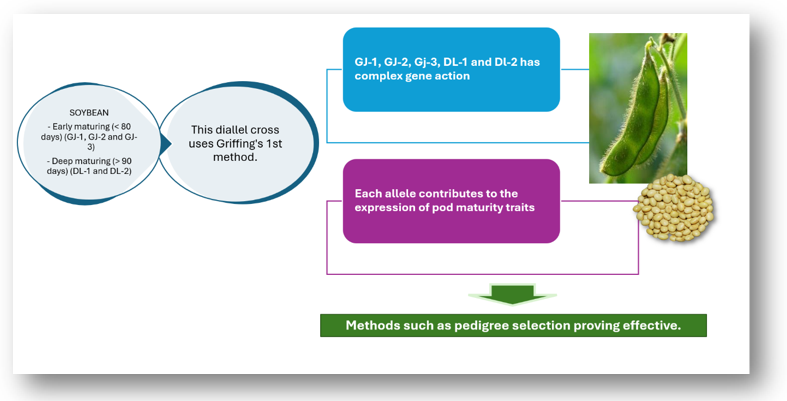
METHODS: The study material for crosses is early maturing (< 80 days) soybean genotypes, namely GJ-1, GJ-2, and GJ-3, and late maturing (> 90 days), namely DL-1 and DL-2. These elders were crossed, including backcrossing (reciprocal). This diallel cross uses Griffing's 1st method. The entire study material consisted of 5 parents and 20 combinations of crosses between different parents (10 combinations of hybrids and its reciprocally), resulting in 25 treatments. Furthermore, all genetic materials were planted using a randomized block design, repeated three times. Cross-diallel statistical analysis and genetic variant components were estimated using the Hayman method.
FINDINGS: The study showed that soybean pods' maturity (GJ-1, GJ-2, GJ-3, DL-1, and DL-2) had complex gene actions, namely additive, non-additive and reciprocal effects. The imperfect dominant gene action found in genotypes GJ-1, GJ-2, GJ-3, DL-1, and DL-2 shows a small chance of getting offspring that has an earlier maturity than the early maturing parent. There is a link between the genes that influence the age characteristics of mature pods, and each allele contributes to this character. The maturity of the pods in genotype DL-2 is the parent, which has a proportion of recessive alleles, while Dl-1, GJ-1, GJ-2, and Gj-3 are the parents, which have a proportion of dominant alleles that influence character expression age of maturity of pods.
CONCLUSION: Given the important role of the additive gene action observed in the genotypes studied, selection for earlier pod maturity could be initiated in the early generations of soybean breeding programs. These findings have important implications for the development of soybean varieties that are more resistant to environmental stress and able to adapt to changing climatic conditions. Breeding early maturing genotypes can reduce the susceptibility of soybean plants to adverse environmental factors such as short growing season drought. By focusing on genetic traits that promote early maturity, breeders can develop soybean varieties that are more suitable for diverse environmental conditions, especially in regions with limited growing seasons. In addition, these early-maturing varieties can provide farmers with greater flexibility in planting schedules and increase yields, thereby enhancing food security. Thus, the application of these genetic insights can contribute to a more sustainable and resilient agricultural system in the face of global environmental challenges.

Graphical Abstract

Genetic variability of soybean pod maturity traits for environmental resilience and stress resistance using the Hayman model

Highlights

  • The maturity of soybean pods had complex gene actions, namely additive, non-additive and reciprocal effects;
  • The imperfect dominant gene action found in the early maturing genotype shows a small chance of getting progeny that has an earlier maturity than the early maturing parent;
  • The influence of additive gene action has a greater value than the action of dominant genes. This shows that the characteristics of mature poda ge in the parents can be inherited from the progeny;
  • The role of additive gene action in parents tested for breeding programs to improve maturity of pods in soybean plants suggests that selection can start in the early generations.

Keywords

Subjects

OPEN ACCESS

©2025 The author(s). This article is licensed under a Creative Commons Attribution 4.0 International License, which permits use, sharing, adaptation, distribution and reproduction in any medium or format, as long as you give appropriate credit to the original author(s) and the source, provide a link to the Creative Commons license, and indicate if changes were made. The images or other third party material in this article are included in the article’s Creative Commons license, unless indicated otherwise in a credit line to the material. If material is not included in the article’s Creative Commons license and your intended use is not permitted by statutory regulation or exceeds the permitted use, you will need to obtain permission directly from the copyright holder. To view a copy of this license, visit: 

http://creativecommons.org/licenses/by/4.0/


PUBLISHER NOTE

GJESM Publisher remains neutral concerning jurisdictional claims in published maps and institutional affiliations.


CITATION METRICS & CAPTURES

Google Scholar | Scopus | Web of Science | PlumX Metrics | Altmetrics | Mendeley |


CURRENT PUBLISHER

GJESM Publisher

Letters to Editor

GJESM Journal welcomes letters to the editor for the post-publication discussions and corrections which allows debate post publication on its site, through the Letters to Editor. Letters pertaining to manuscript published in GJESM should be sent to the editorial office of GJESM within three months of either online publication or before printed publication, except for critiques of original research. Following points are to be considering before sending the letters (comments) to the editor.

[1] Letters that include statements of statistics, facts, research, or theories should include appropriate references, although more than three are discouraged.
[2] Letters that are personal attacks on an author rather than thoughtful criticism of the author’s ideas will not be considered for publication.
[3] Letters can be no more than 300 words in length.
[4] Letter writers should include a statement at the beginning of the letter stating that it is being submitted either for publication or not.
[5] Anonymous letters will not be considered.
[6] Letter writers must include their city and state of residence or work.
[7] Letters will be edited for clarity and length.

Send comment about this article
Enter Name.
Enter a valid email address.
Enter a vaid affiliation.
Enter comments (At leaset 10 words)
CAPTCHA Image
Enter Security Code Correctly.

Article Podcasts

  • Receive Date 27 August 2024
  • Revise Date 02 November 2024
  • Accept Date 04 December 2024