Eco-friendly botanical insecticides to control brown leafhoppers and their effects on the predators and aquatic environment

Document Type : RESEARCH ARTICLE

Authors

1 Research Center for Horticulture, National Research and Innovation Agency, Jl. Raya Jakarta-Bogor, Cibinong, Indonesia

2 Research Center for Fishery, National Research and Innovation Agency, Jl. Raya Jakarta-Bogor, Cibinong, Indonesia

3 Research Center for Food Crops, National Research and Innovation Agency, Jl. Raya Jakarta-Bogor, Cibinong, Indonesia

4 Research Center for Estate Crops, National Research and Innovation Agency, Jl. Raya Jakarta-Bogor, Cibinong, Indonesia

Abstract
BACKGROUND AND OBJECTIVES: The brown planthopper (Nilaparvata lugens) (Hemiptera: Delphacidae) is a major pest in rice cultivation, frequently causing severe crop losses. Traditionally, the approach to managing this problem has been predominantly reliant on synthetic insecticides, which carry substantial environmental and health hazards. The objective of this field study was to evaluate the performance of a botanical insecticide in lowering pest populations, boosting rice yield, and sustaining ecological equilibrium.
METHODS: The research tested Rajam 65 emulsifiable concentrate (patent number individual development plan 00202007448), a botanical insecticide, alone and in combination with a synthetic insecticide containing buprofezin as the active ingredient. Treatments were applied four times at weekly intervals. The study included observations on pest reduction rates, improvements in rice yields, the dynamics of predator populations, and laboratory toxicity tests conducted on tilapia and common carp to determine aquatic safety.
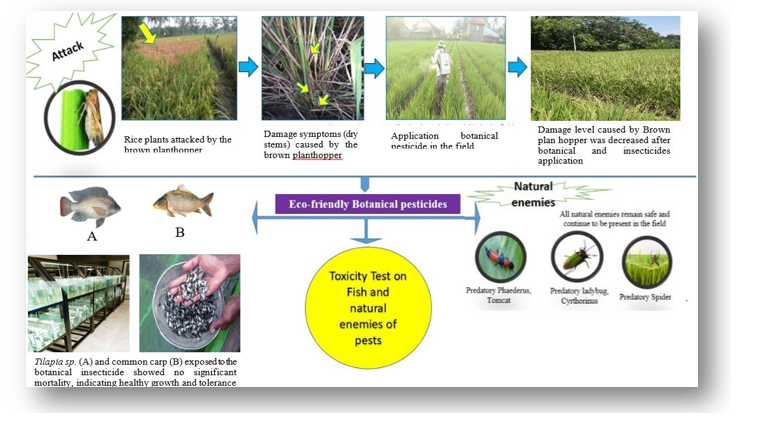
FINDINGS: Results showed that the botanical insecticide alone achieved 97 percent pest mortality, reducing the population from 16.3 to 0.73 individuals per clump and keeping infestations below the economic threshold. Following the combination treatment, pest populations were significantly reduced from 26.63 to 2.17 individuals per clump. Furthermore, there was a notable increase of 16.39 percent in rice yield as a result of the treatment. Natural predator populations, such as spiders and Cyrthorinus lividipennis, remained stable across treatments, demonstrating the insecticide's compatibility with integrated pest management systems. The results of toxicity testing showed that there is a low level of risk to aquatic species like common carp and tilapia. The 96-hour lethal concentration caused 50 percent mortalities values of the botanical insecticide for common carp and tilapia are 0.101 and 0.144 critical concentrate per liters, with toxicity units of 0.025 and 0.017, respectively. Given that these values fall below 0.3, the insecticide poses no harm and is deemed safe for fish farming in the waters of paddy fields.
CONCLUSION: The botanical insecticide proved highly effective in controlling N ilaparvata lugenspopulations while demonstrating ecological and economic benefits. By applying treatments on a weekly basis, pest populations were effectively diminished to levels far below the economic threshold, which in turn enhanced rice yield. The insecticide's sustainable attributes, including its eco-friendliness, scalability, and compatibility with integrated pest management, emphasize its potential as a viable alternative to synthetic chemicals for controlling pests in rice cultivation.

Graphical Abstract

Eco-friendly botanical insecticides to control brown leafhoppers and their effects on the predators and aquatic environment

Highlights

  • The botanical insecticide proved highly effective, reducing brown planthopper populations to 0.73 insects per clump. This performance was notably superior to synthetic treatment outcomes;
  • Despite moderate initial pest attacks characterized by visible crop damage, the botanical treatments successfully restored plant health and prevented economic loss;
  • Natural predators, such as spiders and Cyrthorinus lividipennis, were better conserved under botanical insecticide applications. This contributed to maintaining ecological balance in treated areas;
  • Low toxicity of the botanical insecticide for fish species, evidenced by 96-hour LC50 values, underscores its environmental safety and suitability for rice-field ecosystems.

Keywords

Subjects

OPEN ACCESS

©2025 The author(s). This article is licensed under a Creative Commons Attribution 4.0 International License, which permits use, sharing, adaptation, distribution and reproduction in any medium or format, as long as you give appropriate credit to the original author(s) and the source, provide a link to the Creative Commons license, and indicate if changes were made. The images or other third party material in this article are included in the article’s Creative Commons license, unless indicated otherwise in a credit line to the material. If material is not included in the article’s Creative Commons license and your intended use is not permitted by statutory regulation or exceeds the permitted use, you will need to obtain permission directly from the copyright holder. To view a copy of this license, visit: 

http://creativecommons.org/licenses/by/4.0/


PUBLISHER NOTE

GJESM Publisher remains neutral concerning jurisdictional claims in published maps and institutional affiliations.


CITATION METRICS & CAPTURES

Google Scholar | Scopus | Web of Science | PlumX Metrics | Altmetrics | Mendeley |


CURRENT PUBLISHER

GJESM Publisher

Letters to Editor

GJESM Journal welcomes letters to the editor for the post-publication discussions and corrections which allows debate post publication on its site, through the Letters to Editor. Letters pertaining to manuscript published in GJESM should be sent to the editorial office of GJESM within three months of either online publication or before printed publication, except for critiques of original research. Following points are to be considering before sending the letters (comments) to the editor.

[1] Letters that include statements of statistics, facts, research, or theories should include appropriate references, although more than three are discouraged.
[2] Letters that are personal attacks on an author rather than thoughtful criticism of the author’s ideas will not be considered for publication.
[3] Letters can be no more than 300 words in length.
[4] Letter writers should include a statement at the beginning of the letter stating that it is being submitted either for publication or not.
[5] Anonymous letters will not be considered.
[6] Letter writers must include their city and state of residence or work.
[7] Letters will be edited for clarity and length.

Send comment about this article
Enter Name.
Enter a valid email address.
Enter a vaid affiliation.
Enter comments (At leaset 10 words)
CAPTCHA Image
Enter Security Code Correctly.

Article Podcasts

  • Receive Date 25 August 2024
  • Revise Date 28 October 2024
  • Accept Date 02 December 2024