Document Type : RESEARCH ARTICLE
Authors
1
Department of Electrical Engineering, College of Engineering in Wadi Alddawasir, Prince Sattam Bin Abdulaziz University, Wadi Alddawasir 11991, Saudi Arabia
2
Computer Engineering and Networks Department, College of Engineering, PSAU, Saudi Arabia
3
Pharmacy Department, Cairo University Hospitals, Cairo University, Cairo 11662, Egypt
4
Department of Electrical Engineering, University of Engineering and Technology Peshawar, Pakistan
5
Department of Applied Science, Ajloun University College, Al-Balqa Applied University, Ajloun, Jordan
6
Computers and Systems Department, Electronics Research Institute, Cairo, Egypt
Abstract
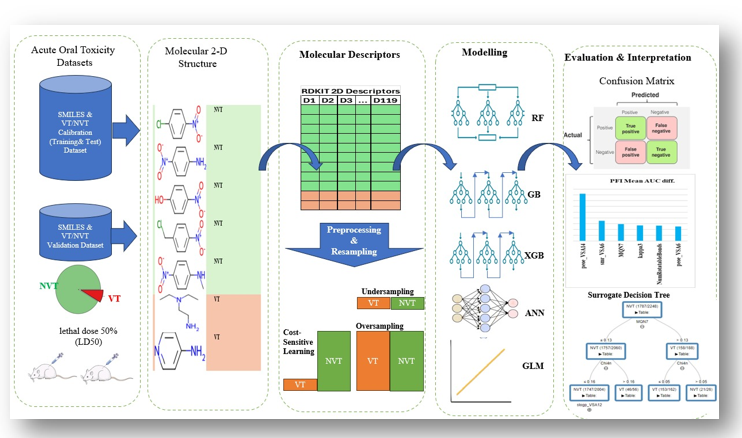
BACKGROUND AND OBJECTIVES: The focus of this study is on the importance of reliable and precise forecasting of acute oral toxicity to bolster chemical safety and advance sustainable development goals, particularly sustainable development goals-3 (good health and well-being), sustainable development goals-6 (clean water and sanitation), and sustainable development goals-12 (responsible consumption and production). Traditional toxicity assessments are often time-consuming and costly, necessitating the exploration of more efficient approaches. The focus of this study is to establish the most efficient method for constructing reliable and precise models for toxicity prediction.
METHODS: The random forests were evaluated, a robust ensemble method, for predicting acute oral toxicity using a comprehensive dataset from National Toxicology Program/Interagency Center for the Evaluation of Alternative Toxicological Methods and Environmental Protection Agency/National Center for Competency Testing, which presented significant class imbalance, 8 percent very toxic 92 percent not very toxic. To address this imbalance, strategies such as cost-sensitive learning and data resampling techniques, including both under sampling and oversampling, were utilized. A diverse set of two-dimensional molecular descriptors generated via rational discovery kit were used as input features, and model preprocessing involved normalization, validation, and feature selection. Hyper-parameter tuning was conducted using Bayesian optimization and cross-validation, while the performance of random forests was evaluated in comparison to gradient boosting, extreme gradient boosting, artificial neural networks, and the generalized linear model.
FINDINGS: The random forests models, particularly those utilizing under sampling and cost-sensitive learning, demonstrated superior performance, achieving sensitivity of 0.81, Specificity of 0.85, accuracy of 0.85, and an area under the receiver operating characteristic curve of 0.89 on an independent test set. An examination of feature importance has shown that the primary molecular descriptors are those related to the Van der waals surface area and molecular quantum numbers. A surrogate decision tree developed from random forests predictions reached an area under the curve of 0.929.
CONCLUSION: Random forest models effectively predicted acute oral toxicity, particularly when addressing class imbalance through cost-sensitive learning and resampling. leveraging explainable artificial intelligence techniques, including permutation feature importance, surrogate decision tree analysis and local interpretable model-agnostic explanations, this study identified key molecular descriptors driving toxicity. This advancement improves model interpretability and represents a significant step toward enhancing chemical safety while supporting sustainable development goals.
Graphical Abstract
Highlights
- Random Forest models outperformed Gradient Boosting, XGBoost, Artificial Neural Networks, and Generalized Linear Model in predicting acute oral toxicity, achieving an AUC of 0.89;
- Class imbalance was addressed using cost-sensitive learning and data resampling techniques, improving the sensitivity (0.81) and specificity (0.85) of Random Forest models models;
- Key molecular descriptors, including slogp_VSA12, peoe_VSA14, and MQN7, were identified as top contributors to toxicity prediction across various feature importance evaluation methods;
- Surrogate Decision Tree analysis of the Random Forest model further enhanced interpretability, achieving an AUC of 0.929 in class prediction.
Keywords
Subjects
OPEN ACCESS
©2025 The author(s). This article is licensed under a Creative Commons Attribution 4.0 International License, which permits use, sharing, adaptation, distribution and reproduction in any medium or format, as long as you give appropriate credit to the original author(s) and the source, provide a link to the Creative Commons license, and indicate if changes were made. The images or other third party material in this article are included in the article’s Creative Commons license, unless indicated otherwise in a credit line to the material. If material is not included in the article’s Creative Commons license and your intended use is not permitted by statutory regulation or exceeds the permitted use, you will need to obtain permission directly from the copyright holder. To view a copy of this license, visit:
http://creativecommons.org/licenses/by/4.0/
PUBLISHER NOTE
GJESM Publisher remains neutral concerning jurisdictional claims in published maps and institutional affiliations.
CITATION METRICS & CAPTURES
Google Scholar | Scopus | Web of Science | PlumX Metrics | Altmetrics | Mendeley |
CURRENT PUBLISHER
GJESM Publisher




Letters to Editor
[1] Letters that include statements of statistics, facts, research, or theories should include appropriate references, although more than three are discouraged.
[2] Letters that are personal attacks on an author rather than thoughtful criticism of the author’s ideas will not be considered for publication.
[3] Letters can be no more than 300 words in length.
[4] Letter writers should include a statement at the beginning of the letter stating that it is being submitted either for publication or not.
[5] Anonymous letters will not be considered.
[6] Letter writers must include their city and state of residence or work.
[7] Letters will be edited for clarity and length.