Document Type : RESEARCH ARTICLE
Authors
1
Department of Biology, Faculty of Mathematics and Natural Sciences, Universitas Indonesia, Gedung E, Kampus UI Depok, Depok 16424, Indonesia
2
The United Graduate School of Agricultural Sciences, Ehime University, 3-5-7 Tarumi, Matsuyama 790-8566, Japan
3
Faculty of Engineering, Ehime University, 3 Bunkyo-cho Matsuyama 790-8577 Japan
4
Occupational Health and Safety Department, Faculty of Public Health, Universitas Indonesia, Depok 16424, West Java, Indonesia
Abstract
BACKGROUND AND OBJECTIVES: The increasing pollution of aquatic environments due to heavy metals has raised concerns over recent decades. Heavy metal contaminants in the aquaculture water of common carp (Cyprinus carpio) jeopardizes aquatic organisms and poses potential health risks to individuals who consume these fish. Zeolite is known for its potential to adsorb heavy metals in water, thereby reducing their accumulation in fish. The current study explored how a zeolite-embedded sheet influences the concentrations of copper and lead in water and common carp. The goal is to present a comprehensive analysis of the influence of the zeolite-embedded sheet on heavy metal levels in both the aquatic environment and the common carp cultivated in modified glass aquariums.
METHODS: This study involved the fabrication and characterization of zeolite-embedded sheets, aquarium modification, fish acclimatization, preparation and dosing of test solutions, adsorption experiments, and the measurement of heavy metal levels in water and fish samples. A range of metal concentrations was assessed in aquariums equipped with zeolite-embedded sheets compared to those without. The aquarium configuration was optimized to improve the process of metal extraction.
FINDINGS: The fabrication of the sheet adsorbent has been successfully accomplished, showing properties that are in agreement with prior studies. Heavy metal levels in both water and carp were higher in the control group (without zeolite-embedded sheets) than in the treatment group (with zeolite-embedded sheets). Copper removal in water ranged from 49.12 to 55.56 percent, while removal in carp ranged from 8.08 to 52.33 percent. Lead removal was higher, with rates of 50.8 to 91.78 percent in water and 82.03 to 88.07 percent in carp. Key water quality indicators, including temperature, potential of hydrogen, and levels of dissolved oxygen, were maintained within the optimal thresholds necessary for successful fish farming. A two-way analysis of variance showed that while the combination of dose and adsorbent did not significantly impact metal content. In contrast, the adsorbent alone exhibited a notable impact, particularly on lead levels in both water and carp, along with copper levels in water.
CONCLUSION: Sheet-type adsorbents effectively reduced metal levels in water and common carp. Although the metal concentrations utilized in this study were relatively low, the adsorbent showed remarkable sorption performance. Future studies should explore its application with higher metal concentrations and on a larger scale, such as in commercial carp cultivation.
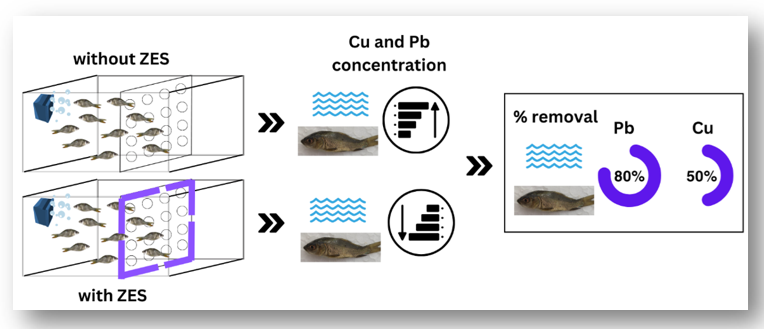
Graphical Abstract
Highlights
- An increase in Pb and Cu levels was observed in common carp that were not treated with ZES, indicating significant bioaccumulation, even at low dosages;
- Low dosages of both Cu and Pb given showed no effect on metal levels in water and common carp in both treatments but on water temperature;
- In the blank treatment, ZES showed removal of Cu in common carp, detecting a lower level of 0.4 mg/L compared to the preliminary test result of 0.9 mg/L;
- The percentage of Pb metal removal by ZES in water and common carp reached 80% greater than the removal of Cu metal which was only 50%.
Keywords
Subjects
OPEN ACCESS
©2025 The author(s). This article is licensed under a Creative Commons Attribution 4.0 International License, which permits use, sharing, adaptation, distribution and reproduction in any medium or format, as long as you give appropriate credit to the original author(s) and the source, provide a link to the Creative Commons license, and indicate if changes were made. The images or other third party material in this article are included in the article’s Creative Commons license, unless indicated otherwise in a credit line to the material. If material is not included in the article’s Creative Commons license and your intended use is not permitted by statutory regulation or exceeds the permitted use, you will need to obtain permission directly from the copyright holder. To view a copy of this license, visit:
http://creativecommons.org/licenses/by/4.0/
PUBLISHER NOTE
GJESM Publisher remains neutral concerning jurisdictional claims in published maps and institutional affiliations.
CITATION METRICS & CAPTURES
Google Scholar | Scopus | Web of Science | PlumX Metrics | Altmetrics | Mendeley |
CURRENT PUBLISHER
GJESM Publisher




Letters to Editor
[1] Letters that include statements of statistics, facts, research, or theories should include appropriate references, although more than three are discouraged.
[2] Letters that are personal attacks on an author rather than thoughtful criticism of the author’s ideas will not be considered for publication.
[3] Letters can be no more than 300 words in length.
[4] Letter writers should include a statement at the beginning of the letter stating that it is being submitted either for publication or not.
[5] Anonymous letters will not be considered.
[6] Letter writers must include their city and state of residence or work.
[7] Letters will be edited for clarity and length.