Document Type : CASE STUDY
Authors
1
Water and Environment Engineering, Department of Land, Water and Environment, The University of Jordan, Amman 11942, Jordan
2
Chemistry, Department of Chemistry, The University of Jordan, Amman 11942, Jordan
3
Geology, Department of Geology, The University of Jordan, Amman 11942, Jordan
4
Civil and Environment Engineering, Department of Civil, Environmental, Architectural Engineering and Mathematics, University of Brescia, Via Branze, 43, 25123 Brescia, Italy
5
Agricultural Engineering, Department of Land, Water and Environment, The University of Jordan, Amman 11942, Jordan
Abstract
BACKGROUND AND OBJECTIVES: Dams are vital for water management but significantly impact local communities. Balancing development with sustainability requires understanding these effects. The study aims to explore the complex interconnection between dam sustainability, water quality chemistry, and local communities.
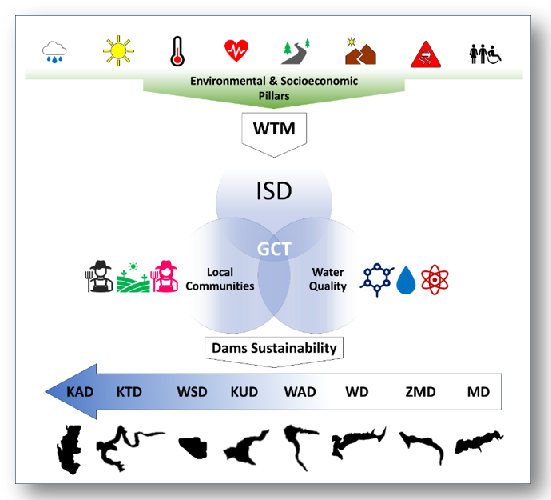
METHODS: The environmental pillar for Jordanian dams was shaped by climate conditions and seismic activity, while the socioeconomic factors involved intersections density, population growth, and unemployment in the areas surrounding the dams, all of which significantly influence dam sustainability. The Wroclaw Taxonomic Method was used to develop the Index of Sustainable Dams, while the Granger Causality Test assessed causal connections among sustainability pillars.
FINDINGS: The study classified dams performance using the Index of Sustainable Dams values. High-performance dams, with values from 0.010 to 0.299, included Kafrein, King Talal, and Wadi Shu'eib dams. Moderate performance, ranging from 0.299 to 0.528, comprised only Kufranja dam. Low-performance dams, with values from 0.528 to 0.937, included Wala, Wadi Arab, Zarqa-Main, and Mujib dams. Moreover, the findings reveal that the dams were significantly influenced by chemical factors (electrical conductivity and the biological oxygen demand to chemical oxygen demand ratio). An average electrical conductivity of 1116 microsiemens per centimeter negatively affects dam sustainability and community engagement, highlighting water salinity's detrimental impact. Conversely, a biological oxygen demand to chemical oxygen demand ratio of 0.09 positively influences sustainability and agricultural productivity, suggesting more efficient organic matter processing in well-functioning systems. Additionally, 8.6 percent of agricultural employment and 1.4 percent of female participation play crucial roles in shaping dams sustainability.
CONCLUSION: Strong bidirectional causal relationships were observed between dams sustainability and changes in employment opportunities in the agricultural sector. Dam managers can use the index for Jordanian dams to pinpoint weaknesses, prioritize improvements, and track progress for enhanced sustainability.
Graphical Abstract
Highlights
- A novel interplay between social, economic, and environmental factors influencing dam sustainability in Jordan is identified, addressing a significant research gap that has been overlooked in previous studies;
- Higher electrical conductivity is found to negatively impact dam sustainability and local community engagement, highlighting the urgent need for interventions addressing water salinity issues to support sustainable agricultural practices;
- The combination of the Wroclaw Taxonomic Method and Granger causality test offers a robust framework for evaluating dam performance, advocating for the application of these versatile methods in future sustainability research.
Keywords
Subjects
OPEN ACCESS
©2025 The author(s). This article is licensed under a Creative Commons Attribution 4.0 International License, which permits use, sharing, adaptation, distribution and reproduction in any medium or format, as long as you give appropriate credit to the original author(s) and the source, provide a link to the Creative Commons license, and indicate if changes were made. The images or other third party material in this article are included in the article’s Creative Commons license, unless indicated otherwise in a credit line to the material. If material is not included in the article’s Creative Commons license and your intended use is not permitted by statutory regulation or exceeds the permitted use, you will need to obtain permission directly from the copyright holder. To view a copy of this license, visit:
http://creativecommons.org/licenses/by/4.0/
PUBLISHER NOTE
GJESM Publisher remains neutral concerning jurisdictional claims in published maps and institutional affiliations.
CITATION METRICS & CAPTURES
Google Scholar | Scopus | Web of Science | PlumX Metrics | Altmetrics | Mendeley |
CURRENT PUBLISHER
GJESM Publisher




Letters to Editor
[1] Letters that include statements of statistics, facts, research, or theories should include appropriate references, although more than three are discouraged.
[2] Letters that are personal attacks on an author rather than thoughtful criticism of the author’s ideas will not be considered for publication.
[3] Letters can be no more than 300 words in length.
[4] Letter writers should include a statement at the beginning of the letter stating that it is being submitted either for publication or not.
[5] Anonymous letters will not be considered.
[6] Letter writers must include their city and state of residence or work.
[7] Letters will be edited for clarity and length.