Document Type : CASE STUDY
Authors
1
Al-Farabi Kazakh National University, Almaty, 050040, Kazakhstan
2
Kazakh National Agrarian Research University, Almaty, 050010, Kazakhstan
3
Zhangir Khan West Kazakhstan Agrarian and Technical University, Uralsk, 090009, Kazakhstan
4
Kazakh research institute of plant protection and quarantine named after Zh. Zhiembayev, Almaty, 050070, Kazakhstan
5
Institute of Plant Biology and Biotechnology, Almaty, 050040, Kazakhstan
6
Institute of zoology, Almaty, 050060, Kazakhstan
Abstract
BACKGROUND AND OBJECTIVES: In recent years, there has been an increased need to reduce chemical pollutants, and studies of entomopathogenic fungi, which are natural regulators for several harmful insects, has become widespread. Entomopathogenic fungi are inexhaustible source of natural strains that have a broad range of virulence in many species of harmful insects. Among entomopathogenic anamorphic ascomycetes, those fungi from the genus Beauveria are most studied. Studies have been conducted for the past two hundred years, meaning that most mycoinsecticides are based on the results of these studies. Although these fungi are considered well-studied, research into the cryptic species composition of genus Beauveria and their geographical distribution remains relevant for identifying promising strains for pest control. This study aims to investigate the biodiversity of the genus Beauveria prevalent in the soils of southern Kazakhstan (Turkestan region).
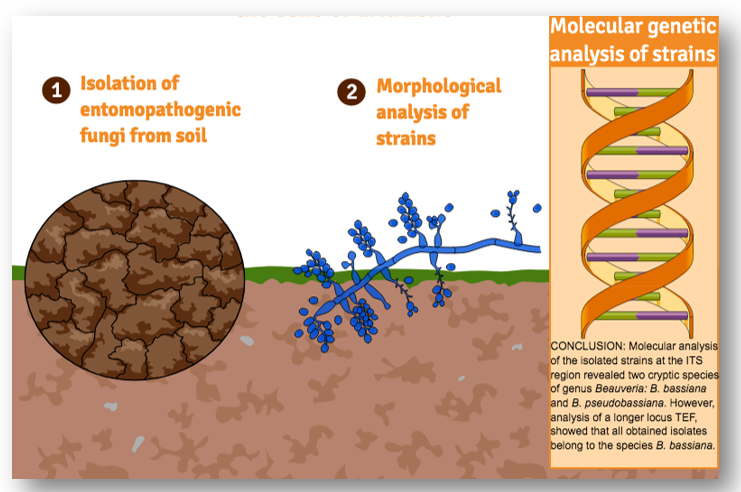
METHODS: Entomopathogenic fungi of the genus Beauveria are widespread in the natural ecosystem, including soil. Therefore, during 2023-2024 soil samples from various locations in southern Kazakhstan (Turkestan region) were collected to isolate entomopathogenic fungi. The insect bait method was used to isolate entomopathogenic fungi. Larvae of Tenebrio molitor (Coleoptera: Tenebrionidae) were used as baits, with five replicates per sample, and placed in soil samples inside plastic containers. After infection, dead larvae were transferred to a moist chamber to promote mycosis development. Fungal conidia were then transferred to Sabouraud’s agar medium. Species identification of the isolated fungi was conducted using classical light microscopy and molecular genetic analysis of internal transcribed spacer regions and the translation elongation factor 1 alpha gene.
FINDINGS: 41 isolates were isolated into pure culture, of which 36 were fully identified. Polymerase chain reaction analysis of the translation elongation factor 1-alpha gene revealed that all isolates belong to Beauveria bassiana. However, analysis of the internal transcribed spacer region identified two cryptic species within the genus Beauveria: Beauveria bassiana and Beauveria pseudobassiana. The majority of the isolates were identified as Beauveria bassiana – 84 percent (31 isolates), while Beauveria pseudobassiana accounted for 16 percent (5 isolates).
CONCLUSION: The species composition of entomopathogenic fungi in the soils of southern Kazakhstan (Turkestan region) turned out to be quite modest and sparse, which explains the soil and climatic conditions of the region. A distinctive feature of the climate of the study region is aridity. Only fungi of the genus Beauveria were isolated, which are considered cosmopolitan. Isolation of viable entomopathogenic fungi demonstrates adaptation to arid conditions, which is very important in the context of climate change.
Graphical Abstract
Keywords
Subjects
OPEN ACCESS
©2025 The author(s). This article is licensed under a Creative Commons Attribution 4.0 International License, which permits use, sharing, adaptation, distribution and reproduction in any medium or format, as long as you give appropriate credit to the original author(s) and the source, provide a link to the Creative Commons license, and indicate if changes were made. The images or other third party material in this article are included in the article’s Creative Commons license, unless indicated otherwise in a credit line to the material. If material is not included in the article’s Creative Commons license and your intended use is not permitted by statutory regulation or exceeds the permitted use, you will need to obtain permission directly from the copyright holder. To view a copy of this license, visit:
http://creativecommons.org/licenses/by/4.0/
PUBLISHER NOTE
GJESM Publisher remains neutral concerning jurisdictional claims in published maps and institutional affiliations.
CITATION METRICS & CAPTURES
Google Scholar | Scopus | Web of Science | PlumX Metrics | Altmetrics | Mendeley |
CURRENT PUBLISHER
GJESM Publisher




Letters to Editor
[1] Letters that include statements of statistics, facts, research, or theories should include appropriate references, although more than three are discouraged.
[2] Letters that are personal attacks on an author rather than thoughtful criticism of the author’s ideas will not be considered for publication.
[3] Letters can be no more than 300 words in length.
[4] Letter writers should include a statement at the beginning of the letter stating that it is being submitted either for publication or not.
[5] Anonymous letters will not be considered.
[6] Letter writers must include their city and state of residence or work.
[7] Letters will be edited for clarity and length.