Document Type : REVIEW PAPER
Authors
1
Laboratorio de Física del Plasma, Universidad Nacional de Colombia Sede Manizales, Manizales 170003, Colombia
2
Facultad de Ciencias Básicas, Universidad Tecnológica de Pereira, Pereira 660003, Colombia
3
Department of Natural and Exact Sciences, Universidad Nacional de Colombia Sede Manizales, Manizales 170003, Colombia
4
Gestión and Medio Ambiente, Manizales 170004, Colombia
5
PCM Computational Applications, Universidad Nacional de Colombia Sede Manizales, Manizales 170003, Colombia
6
Department of Natural and Exact Sciences, Universidad de la Costa, Barranquilla 080002, Colombia
Abstract
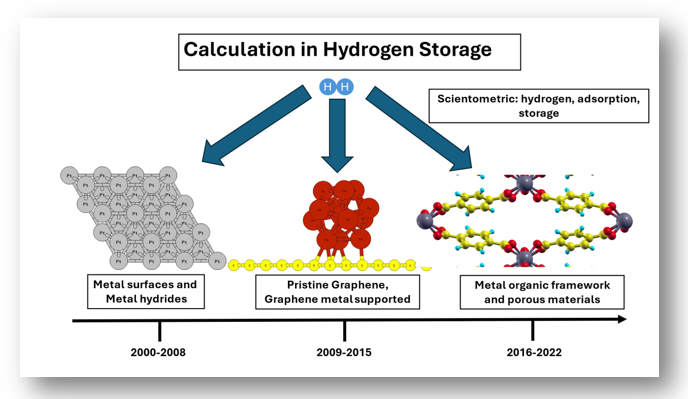
The rapid industrialization has driven economic growth and population increase, but it has also led to significant environmental issues and energy shortages. In order to overcome these challenges and shift towards a carbon-neutral energy system, it is vital to investigate clean energy alternatives and lessen the reliance on fossil fuels. Among these alternatives, hydrogen stands out as a leading candidate due to its energy density and environmental affinity, being both abundant and renewable. This study presents a comprehensive overview of the annual scientific production in the field of hydrogen adsorption and storage, categorized by country and authorship with the aim of assessing its evolution, thematic development, and global collaboration pattern. The present research was conducted in the databases Web of Science and Scopus from 2000 to 2022, using a pre-determined set of keywords related to hydrogen adsorption, storage, and density functional theory. The retrieved data were analysed with the Bibliometrix package in RStudio to evaluate publication trends, research evolution across three distinct periods and global collaboration networks. The present study involved the identification of 2183 documents, which were then screened and categorized by relevance in relation with hydrogen storage. In the present work, 881 articles were assessed for eligibility, identifying 60 key studies through degree and PageRank metrics, the evolution of research is delved into throughout three key stages. The three distinct periods identified were: the initial stage (2000-2008) which was marked by fundamental work on ionic liquids and hydrogen storage. The intermediate stage (2009-2015) witnesses an increase in scientific production, addressing fundamental principles and methodologies with a focus on metal-organic frameworks. The current stage (2016-2022) reflects maximum productivity and shows cutting-edge studies on nanotubes and electrocatalysts for the efficient evolution of hydrogen. The study explores global collaboration networks between countries and identifies influential authors and leading journals in the field. By the identification of the key trends, this study highlights the emergence of novel materials and technologies that are reshaping the hydrogen storage landscape. These advancements suggest potential pathways for future research and innovation, ultimately contributing to the development of sustainable energy solutions. This bibliometric analysis provides valuable insights into the trends, contributions, and collaborative dynamics shaping the of hydrogen adsorption and storage research landscape.
Graphical Abstract
Highlights
- The study compiles existing literature on computational calculations related to hydrogen adsorption over the past two decades, utilizing a bibliometric analysis based on data from Scopus and WoS;
- This study identifies novel materials like metal-organic frameworks and carbon-based structures with enhanced hydrogen storage efficiency at room temperature;
- The study reveals an evolution in hydrogen adsorption research, highlighting a shift toward metal-organic frameworks and nanotube-based materials from 2016 to 2022;
- The analysis maps out key global collaborations in hydrogen storage research, identifying China, the USA, and India as leading contributors;
- The application of computational techniques, particularly density functional theory, has significantly advanced our understanding of hydrogen adsorption dynamics.
Keywords
Subjects
OPEN ACCESS
©2025 The author(s). This article is licensed under a Creative Commons Attribution 4.0 International License, which permits use, sharing, adaptation, distribution and reproduction in any medium or format, as long as you give appropriate credit to the original author(s) and the source, provide a link to the Creative Commons license, and indicate if changes were made. The images or other third party material in this article are included in the article’s Creative Commons license, unless indicated otherwise in a credit line to the material. If material is not included in the article’s Creative Commons license and your intended use is not permitted by statutory regulation or exceeds the permitted use, you will need to obtain permission directly from the copyright holder. To view a copy of this license, visit:
http://creativecommons.org/licenses/by/4.0/
PUBLISHER NOTE
GJESM Publisher remains neutral concerning jurisdictional claims in published maps and institutional affiliations.
CITATION METRICS & CAPTURES
Google Scholar | Scopus | Web of Science | PlumX Metrics | Altmetrics | Mendeley |
CURRENT PUBLISHER
GJESM Publisher




Letters to Editor
[1] Letters that include statements of statistics, facts, research, or theories should include appropriate references, although more than three are discouraged.
[2] Letters that are personal attacks on an author rather than thoughtful criticism of the author’s ideas will not be considered for publication.
[3] Letters can be no more than 300 words in length.
[4] Letter writers should include a statement at the beginning of the letter stating that it is being submitted either for publication or not.
[5] Anonymous letters will not be considered.
[6] Letter writers must include their city and state of residence or work.
[7] Letters will be edited for clarity and length.