Document Type : RESEARCH ARTICLE
Authors
1
Department of Biology, Faculty of Mathematics and Natural Sciences, Universitas Indonesia, Gedung E FMIPA, Kampus UI Depok, Depok 16424, West Java, Indonesia
2
Faculty of Science and Marine Environment, Universiti Malaysia Terengganu, 21030 Kuala Nerus, Terengganu, Malaysia
3
Occupational Health and Safety Department, Faculty of Public Health, Universitas Indonesia, Depok 16424, West Java, Indonesia
4
Department of Marine Science, Institut Teknologi dan Bisnis Muhammadiyah Kolaka, Jl. Pramuka, Lamokato, Kolaka 93511, Southeast Sulawesi, Indonesia
Abstract
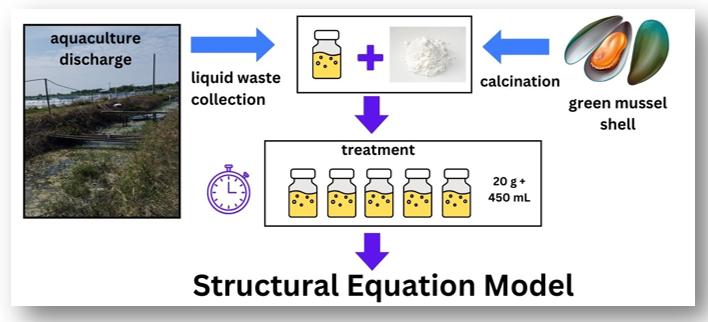
BACKGROUND AND OBJECTIVES: Aquaculture practices were emitting wastewater containing pollutants. The pollutants include heavy metals and nitrite and nitrate. At the same time, clam shell was known as a low-cost and effective pollutant adsorbent that could remove pollutant from the water. This study aimed to model the removal efficiency of clam shell of Perna viridis on copper, zinc, nitrate, and nitrite pollutants from waste water. The model is using the structural equation model.
METHODS: The pollutants observed included copper, zinc, nitrate, and nitrite, considering that those pollutants are common pollutants occurring in aquaculture wastewater. For producing the clam shell adsorbent, the procedures include calcination of clam shells. The modeling analysis to model the pollutant removal efficiency by clam shell was done using the Structural Equation Model method using latent and observed variables. The determinant water variables affecting removal efficiency were total suspended solid, total alkalinity, and potential hydrogen. The model were then validated using the factor loadings.
FINDINGS: The result showed clam shell can reduce the heavy metals from water with a removal efficiency of 84–99 percent. According to model results and factor loading values, water variables that contribute significantly to the metal removals were total alkanility, followed by potential hydrogen. Metal that was affected significantly by those water variables was copper. This is also similar for nitrite and nitrate in water, with nitrite being more affected.
CONCLUSION: In general, clam shell can adsorb diluted pollutants from aquaculture wastewater since there are portions of adsorbed pollutants. The modeling approach is very useful to inform and distinguish particular water variables that may affect the efficiency of pollutant removals by clam shell from wastewaters.
Graphical Abstract
Highlights
- The important water variables affecting the removal efficiency of copper, zinc, nitrate, and nitrite by clam shell were total alkalinity and pH in water;
- A structural equation model can determine the contributions of water variables that significantly affect the efficiency of pollutant removals;
- Total alkalinity and pH in water affect significantly the removals of Cu and nitrite by clamshell.
- The removal efficiency of metals (Cu and Zn) ranges 84%–99%.
Keywords
Subjects
OPEN ACCESS
©2025 The author(s). This article is licensed under a Creative Commons Attribution 4.0 International License, which permits use, sharing, adaptation, distribution and reproduction in any medium or format, as long as you give appropriate credit to the original author(s) and the source, provide a link to the Creative Commons license, and indicate if changes were made. The images or other third party material in this article are included in the article’s Creative Commons license, unless indicated otherwise in a credit line to the material. If material is not included in the article’s Creative Commons license and your intended use is not permitted by statutory regulation or exceeds the permitted use, you will need to obtain permission directly from the copyright holder. To view a copy of this license, visit:
http://creativecommons.org/licenses/by/4.0/
PUBLISHER NOTE
GJESM Publisher remains neutral concerning jurisdictional claims in published maps and institutional affiliations.
CITATION METRICS & CAPTURES
Google Scholar | Scopus | Web of Science | PlumX Metrics | Altmetrics | Mendeley |
CURRENT PUBLISHER
GJESM Publisher




Letters to Editor
[1] Letters that include statements of statistics, facts, research, or theories should include appropriate references, although more than three are discouraged.
[2] Letters that are personal attacks on an author rather than thoughtful criticism of the author’s ideas will not be considered for publication.
[3] Letters can be no more than 300 words in length.
[4] Letter writers should include a statement at the beginning of the letter stating that it is being submitted either for publication or not.
[5] Anonymous letters will not be considered.
[6] Letter writers must include their city and state of residence or work.
[7] Letters will be edited for clarity and length.