Document Type : CASE STUDY
Authors
1
Department of Industrial Engineering, Faculty of Engineering, Universitas Diponegoro, Prof. Sudarto S.H., Tembalang, Semarang, Indonesia
2
Lean and Sustainable Supply Chain Laboratory, Department of Industrial Engineering, Faculty of Engineering, Universitas Diponegoro, Indonesia
3
Environmental Sustainability Research Group, Department of Environmental Engineering, Faculty of Engineering, Universitas Diponegoro, Jl. Prof. Sudarto S.H., Tembalang, Semarang City, Central Java 50275, Indonesia
4
Institute of Environmental Science and Technology, The University of Kitakyushu, 1-1, Hibikino, Wakamatsu-ku, Kitakyushu, Fukuoka, 808-0135, Japan
5
LSBU Business School, London South Bank University, 103 Borough Road, London SE1 0AA, United Kingdom
Abstract
BACKGROUND AND OBJECTIVES: A significant amount of biomass waste remains underutilized in corn and rice farming areas. In Grobogan, Central Java, rice husks, and corn waste are used as energy sources for tofu production, resulting in the formation of rice husk charcoal and corncob charcoal. Consequently, it is essential to develop innovative methods for converting rice husks and burnt cob waste into products of economic value. This study sought to ascertain the ideal mixture of briquettes derived from biomass waste, particularly corncobs, burnt corncobs, burnt rice husks, and polypropylene waste, by analyzing their chemical characteristics and the associated environmental effects.
METHODS: This experimental design was selected to determine the optimal combination of materials for producing high-quality briquettes. In this design, the combination of materials was the independent variable, whereas the chemical characteristics were the dependent variables. The dependent variables selected for this study were derived from the parameters specified by the Indonesian National Standards, which included measurements of water content, calorific value, ash content, and fixed carbon. A life cycle assessment was performed to evaluate the environmental impact of the briquette products manufactured.
FINDINGS: The results of the study showed that corn cob briquettes exhibited better quality than burnt rice husk briquettes based on the Indonesian National Standard parameters. A life cycle assessment pertaining to recycling demonstrated that corn cob briquettes possess a lesser environmental impact. The study indicated that corn cob briquettes, when produced without the inclusion of plastic, exhibited superior chemical properties and a more favorable environmental impact. Corncob without polypropylene had a moisture content of 11.16 percent, ash content of 20.04 percent, fixed carbon content of 77.44 percent, and calorific value of 5,156.93 calories per gram. The environmental impact is equivalent to an eco-cost of 0.387 United States Dollars The findings of the study reveal that corn cob briquettes hold substantial potential for evolution as an alternative energy resource or for integration with fossil fuels in co-firing processes.
CONCLUSION: The findings will assist local governments in guiding the production of biomass briquettes that meet consumer quality standards, while minimizing environmental impact. There is a necessity for further studies to analyze the impediments and challenges involved in the utilization of briquettes as a replacement for fossil energy or in conjunction with fossil fuels in industrial applications, especially within the cement industry in Grobogan Regency.
Graphical Abstract
Highlights
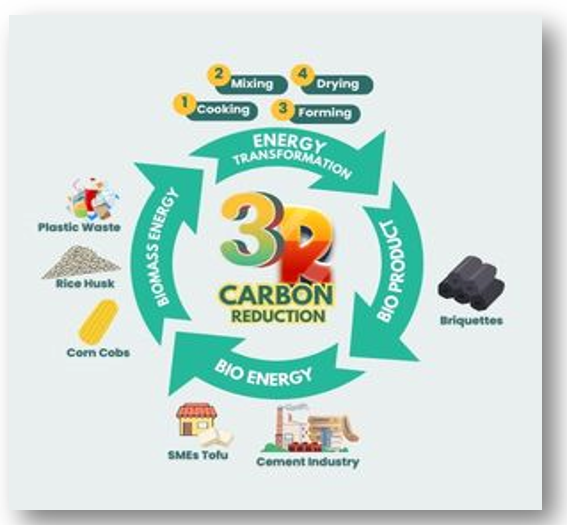
- The study found that briquettes that have better chemical characteristics and small environmental impacts are briquettes made from corn cob waste;
- The briquettes produced can be the source of bioenergy for tofu SMEs and the cement industry in the city;
- Plastic waste is better to be converted to refuse derived fuel rather than using it as an additive in biomass briquettes.
Keywords
Subjects
OPEN ACCESS
©2025 The author(s). This article is licensed under a Creative Commons Attribution 4.0 International License, which permits use, sharing, adaptation, distribution and reproduction in any medium or format, as long as you give appropriate credit to the original author(s) and the source, provide a link to the Creative Commons license, and indicate if changes were made. The images or other third party material in this article are included in the article’s Creative Commons license, unless indicated otherwise in a credit line to the material. If material is not included in the article’s Creative Commons license and your intended use is not permitted by statutory regulation or exceeds the permitted use, you will need to obtain permission directly from the copyright holder. To view a copy of this license, visit:
http://creativecommons.org/licenses/by/4.0/
PUBLISHER NOTE
GJESM Publisher remains neutral concerning jurisdictional claims in published maps and institutional affiliations.
CITATION METRICS & CAPTURES
Google Scholar | Scopus | Web of Science | PlumX Metrics | Altmetrics | Mendeley |
CURRENT PUBLISHER
GJESM Publisher




Letters to Editor
[1] Letters that include statements of statistics, facts, research, or theories should include appropriate references, although more than three are discouraged.
[2] Letters that are personal attacks on an author rather than thoughtful criticism of the author’s ideas will not be considered for publication.
[3] Letters can be no more than 300 words in length.
[4] Letter writers should include a statement at the beginning of the letter stating that it is being submitted either for publication or not.
[5] Anonymous letters will not be considered.
[6] Letter writers must include their city and state of residence or work.
[7] Letters will be edited for clarity and length.