Document Type : RESEARCH ARTICLE
Authors
1
Department of Medical Nanotechnology, School of Advanced Medical Sciences and Technologies, Shiraz University of Medical Sciences, Shiraz, Iran
2
Faculty of Chemical and Energy Engineering, Universiti Teknologi Malaysia, 81310, Skudai, Johor, Malaysia
3
Universidad UTE, Centro de Investigación en Salud Públicay Epidemiología Clínica, Quito 170527, Ecuador
4
Department of Biomaterials, Saveetha Dental College, and Hospital, Saveetha Institute of Medical and Technical Sciences, Chennai, 600 077, India
5
Faculty of Science, Department of Biology and Genetics, Islamic Azad University, Mashhad Branch, Razavi Khorasan, Iran
6
Department of Electrical and Engineering, Faculty of Engineering and Physical Science, Centre of Vision Speech and Processing, University of Surrey, United Kingdom
7
Clean Energy Technologies Research Institute, Process Systems Engineering, Faculty of Engineering and Applied Science, University of Regina, Canada
8
Centre of Research Impact and Outcome, Chitkara University Institute of Engineering and Technology, Chitkara University, Punjab, India
9
Instituto de Alta Investigación, Universidad de Tarapacá, Arica 1000000, Chile
Abstract
BACKGROUND AND OBJECTIVES: The synthesis of mesoporous silica nanoparticles using non-surfactant agents is gaining popularity owing to the easier purification and lower toxicity of this method compared to traditional surfactant-based ones. The potential of mesoporous silica nanoparticles as advanced nanocarriers for health-related applications is increasingly recognized. Quercetin, a potent free-radical scavenging antioxidant that relies heavily on the intracellular supply of reduced glutathione, has garnered significant interest in the scientific community. In spite of recent progress, the mechanisms underlying the development of the porous framework have largely gone unexplored. The primary aim of this study is to explore the feasibility of utilizing quercetin as a template for the synthesis of mesoporous silica nanoparticles, circumventing the need for conventional
METHODS: This research investigates the impact of the chemical structure and properties of polyphenols, specifically quercetin, on their templating potential. The study reveals the arrangement of quercetin, which acts as a model for the development of mesoporous silica nanoparticles, forming a supramolecular structure that facilitates silica binding. The composition of this supramolecular framework leads to unconventional and variable pore structures. The scanning electron microscopy, transmission electron microscopy, Fourier-transform infrared spectroscopy, x-ray diffraction analysis, energy-dispersive X-ray spectroscopy, and Brunauer–Emmett–Teller analysis were used to characterize the quercetin-templated mesoporous silica nanoparticles and provide detailed insights into their morphology.
FINDINGS: The results from the viability test and antiviral assays demonstrated that quercetin-templated mesoporous silica nanoparticles are non-toxic and possess inhibitory and antiviral properties that are comparable to those of Oseltamivir, which served as a positive control. Quercetin served as a non-surfactant, neutral template in an ammonia and ethanol mixture, resulting in approximately spherical particles with monodisperse diameters of about 180 nanometers. These nanoparticles of mesoporous silica showed a concentration-dependent efficacy in inhibiting pathogenic microorganisms. In x-ray diffraction pattern for Mesoporous silica nanoparticles, a number of Bragg's reflections referring to the (111), (200), and (220) sets of lattice planes were detected, which can be described by the fundamental face center cubic structure of mesoporous silica nanostructures. Because of the smaller particle diameter impact and incomplete internal structure of the nanostructures, the intense peak at 2θ= 24 degrees demonstrated the silica peak, which reflected crystalline nature. According to calculations based on the Brunauer–Emmett–Teller method, the specific surface area of Quercetin-templated mesoporous silica nanoparticles was determined to be 55.227 cubic meters. Furthermore, the Barrett-Joyner-Halenda analysis provided measurements of the pore size at 24.312 nm and the pore volume at 0.336 square centimeters per gram, respectively.
CONCLUSION: The study results outcomes demonstrated that quercetin forms a macromolecular scaffold that functions as a template for the formation of mesoporous silica nanoparticles. The irregular pore structure observed is attributed to the unique characteristics of quercetin. Using small-angle X-ray scattering, detailed information was obtained regarding the constituents and the porous nature of the resulting mesoporous silica nanoparticles. This study reveals innovative insights into the mechanisms by which the macromolecular structure of the template governs the dimensions of particles and the process of pore formation. The role of quercetin in the morphogenetic development of mesoporous silica nanoparticles has been thoroughly investigated. In addition, quercetin-templated mesoporous silica nanoparticles exhibited significant antioxidant properties, akin to butylated hydroxytoluene, and showed great potential for various clinical applications.
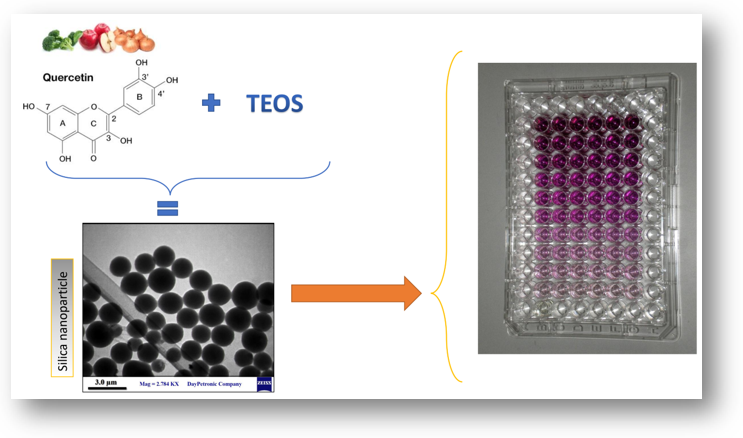
Graphical Abstract
Highlights
- The QU-templated MSNs show non-toxicity and exhibit antiviral and antioxidant properties comparable to established controls, indicating their potential for various health-related applications;
- The findings show that the inclusion of QU led to a gradual increasing trend in crystallite size, particularly in comparison to non-mesoporous nanostructures;
- The findings indicate that the inclusion of QU led to a gradual increasing trend in crystallite size, particularly in comparison to non-mesoporous nanostructures.
Keywords
Subjects
OPEN ACCESS
©2024 The author(s). This article is licensed under a Creative Commons Attribution 4.0 International License, which permits use, sharing, adaptation, distribution and reproduction in any medium or format, as long as you give appropriate credit to the original author(s) and the source, provide a link to the Creative Commons license, and indicate if changes were made. The images or other third party material in this article are included in the article’s Creative Commons license, unless indicated otherwise in a credit line to the material. If material is not included in the article’s Creative Commons license and your intended use is not permitted by statutory regulation or exceeds the permitted use, you will need to obtain permission directly from the copyright holder. To view a copy of this license, visit:
http://creativecommons.org/licenses/by/4.0/
PUBLISHER NOTE
GJESM Publisher remains neutral concerning jurisdictional claims in published maps and institutional affiliations.
CITATION METRICS & CAPTURES
Google Scholar | Scopus | Web of Science | PlumX Metrics | Altmetrics | Mendeley |
CURRENT PUBLISHER
GJESM Publisher




Letters to Editor
[1] Letters that include statements of statistics, facts, research, or theories should include appropriate references, although more than three are discouraged.
[2] Letters that are personal attacks on an author rather than thoughtful criticism of the author’s ideas will not be considered for publication.
[3] Letters can be no more than 300 words in length.
[4] Letter writers should include a statement at the beginning of the letter stating that it is being submitted either for publication or not.
[5] Anonymous letters will not be considered.
[6] Letter writers must include their city and state of residence or work.
[7] Letters will be edited for clarity and length.