Bibliometric analysis of biochar application for environmental management in agricultural sector

Document Type : CASE STUDY

Authors

1 Research Center for Food Crops, National Research and Innovation Agency, Cibinong, Bogor 16911 Indonesia

2 Division of Mathematical and Physical Sciences, Graduate School of Natural Science and Technology, Kanazawa University, Kanazawa, Japan

3 Department of Health Scieces , Faculty of Humanities and Health Sciences, Curtin University, Miri 98000, Malaysia

4 Doctoral School of Management and Organizational Sciece, Hungarian University of Agriculture and Life Science, Kaposvar 7400 Hungary

Abstract
BACKGROUND AND OBJECTIVES: Biochar has gained prominence as a sustainable solution in agriculture and environmental management, with benefits of enhancing soil fertility, improving crop yield, and mitigating the climate change. This study sought to conduct a bibliometric analysis of biochar research within the context of agricultural applications, with the objective of evaluating its progression, thematic development, and patterns of global collaboration.
METHODS: A search was conducted in the Scopus database on September 1, 2024 using a pre-determined keyword combination. The retrieved data were analyzed using the Bibliometrix package in RStudio to evaluate publication trends, research theme evolution, and international collaboration networks. The authors' keywords were employed in a co-occurrence analysis to discern principal research themes and their interrelations. The analysis on research theme evolution utilized a single time split, dividing the datasets into 2006−2021 and 2022−2025. The collaboration network was established with a minimum edge threshold of 4, and it is illustrated in a mapped format. .
FINDINGS: The search using a predetermined keyword combination identified 4,402 publications related to biochar, with 2,857 focused specifically on its application in agriculture. A pronounced increase in research output was observed after 2016. China is spearheading the investigation in this domain, having produced 1,319 publications from individual countries and 564 from various international collaborations. In the second leading position, the United States has produced 382 publications, where 101 of which were published along with authors from other countries. The thematic analysis revealed a transition from the original focal points, which included carbon sequestration, to newly emerging subjects such as microbial biomass and the remediation of heavy metals.
CONCLUSION: There is an increasing significance of biochar research worldwide, where the thematic evolution and patterns of international collaborations have been successfully synthesized in this study. The thematic shifts suggest the growing interest in microbial biomass and heavy metal remediation-related themes, indicating the multiple applications of biochar in both environmental management and agricultural productivity. Given the robust framework of international research collaboration, it is essential to undertake a unified global initiative aimed at standardizing biochar application techniques, enhancing production processes, and evaluating the long-term effects of biochar usage. The production and utility of biochar in agricultural sector could be optimized through international collaboration and policy development aiming to improve soil health, and subsequently food security. The study has effectively mapped the landscape of biochar studies within the realm of environmental management, with a particular focus on its roles in enhancing microbial biomass and remediating heavy metal contamination.

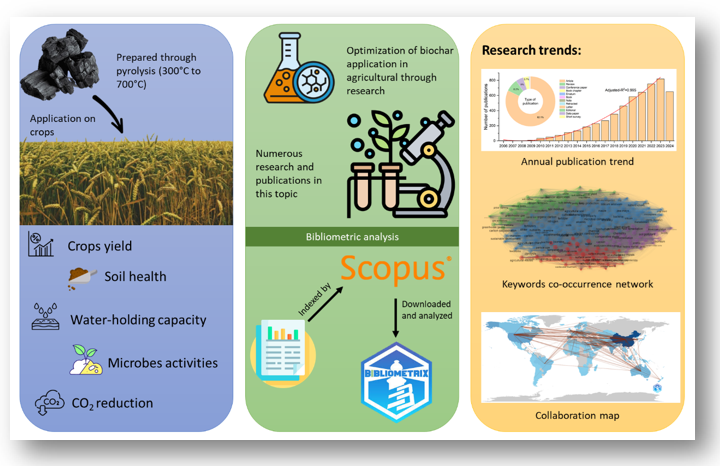
Graphical Abstract

Bibliometric analysis of biochar application for environmental management in agricultural sector

Highlights

  • Based on the publication trends of over the past two decades, biochar research in agriculture experienced significant growth, with the number of publications increasing exponentially (R² = 0.995) and peaking at 819 publications in 2023;
  • China is the leading country in biochar research, with top institutions like Nanjing Agricultural University (865 publications) and Northwest A and F University (559 publications);
  • In China, 1,319 single-country publications related to biochar research has been produced, where there are 564 international collaborations;
  • Thematic analysis reveals a shift from initial focus areas like carbon sequestration to emerging topics such as microbial biomass, soil moisture, and heavy metals from 2006-2021 to 2022-2025.

Keywords

Subjects

OPEN ACCESS

©2024 The author(s). This article is licensed under a Creative Commons Attribution 4.0 International License, which permits use, sharing, adaptation, distribution and reproduction in any medium or format, as long as you give appropriate credit to the original author(s) and the source, provide a link to the Creative Commons license, and indicate if changes were made. The images or other third party material in this article are included in the article’s Creative Commons license, unless indicated otherwise in a credit line to the material. If material is not included in the article’s Creative Commons license and your intended use is not permitted by statutory regulation or exceeds the permitted use, you will need to obtain permission directly from the copyright holder. To view a copy of this license, visit: 

http://creativecommons.org/licenses/by/4.0/


PUBLISHER NOTE

GJESM Publisher remains neutral concerning jurisdictional claims in published maps and institutional affiliations.


CITATION METRICS & CAPTURES

Google Scholar | Scopus | Web of Science | PlumX Metrics | Altmetrics | Mendeley |


CURRENT PUBLISHER

GJESM Publisher

Letters to Editor

GJESM Journal welcomes letters to the editor for the post-publication discussions and corrections which allows debate post publication on its site, through the Letters to Editor. Letters pertaining to manuscript published in GJESM should be sent to the editorial office of GJESM within three months of either online publication or before printed publication, except for critiques of original research. Following points are to be considering before sending the letters (comments) to the editor.

[1] Letters that include statements of statistics, facts, research, or theories should include appropriate references, although more than three are discouraged.
[2] Letters that are personal attacks on an author rather than thoughtful criticism of the author’s ideas will not be considered for publication.
[3] Letters can be no more than 300 words in length.
[4] Letter writers should include a statement at the beginning of the letter stating that it is being submitted either for publication or not.
[5] Anonymous letters will not be considered.
[6] Letter writers must include their city and state of residence or work.
[7] Letters will be edited for clarity and length.

Send comment about this article
Enter Name.
Enter a valid email address.
Enter a vaid affiliation.
Enter comments (At leaset 10 words)
CAPTCHA Image
Enter Security Code Correctly.

Article Podcasts

  • Receive Date 06 May 2024
  • Revise Date 12 July 2024
  • Accept Date 17 September 2024