Document Type : RESEARCH ARTICLE
Authors
1
Institute of Biology, College of Science, University of the Philippines Diliman, Quezon City, Philippines
2
Division of Natural Science and Mathematics, University of the Philippines, Tacloban College, Tacloban City, Philippines
3
United States Department of Agriculture, Forest Service, Koror, Palau
4
Institute of Environmental Science and Meteorology, University of the Philippines Diliman, Quezon City, Philippines
Abstract
BACKGROUND AND OBJECTIVES: Nutrient availability influences mangrove forest structure and productivity. The conversion of mangroves into aquaculture ponds can lead to significant disturbances, resulting in long-term consequences associated with the clearing of vegetation and changes in the physico-chemical properties of the soil. These alterations may subsequently restrict the availability of essential nutrients, including nitrogen and phosphorus. Consequently, nutrient limitations can constrain mangrove growth and development. Conventional indicators of nutrient limitation are founded on the analysis of leaf nutrient and nutrient resorption ratios, drawing from datasets collected in terrestrial and temperate forest environments. However, these indices may not be applicable to mangroves due to the prevalence of a wide range of environmental settings and occurrences of disturbances. In the Philippines, mangrove ecosystems are represented by diverse stand types, including natural or intact mangroves, restored or planted mangroves, and recolonized stands, which are naturally revegetated abandoned ponds. These different stand types are perceived to have different levels of nutrient availability and resorption capabilities. This study aims to investigate the changes in soil and leaf nutrient concentrations of nitrogen and phosphorus, leaf nitrogen to phosphorus ratio, nitrogen and phosphorus resorption efficiencies, and nitrogen resorption efficiency to phosphorus resorption efficiency ratio across a chronosequence of restored and recolonized stands (with intact natural stands as reference sites) in Ormoc Bay, Philippines.
METHODS: Soil and leaf samples were obtained from both seedlings and mature trees across each vegetation plot in restored, recolonized, and natural stands, totaling 30 plots. Soil (total nitrogen and available phosphorus) and leaf (total nitrogen and total phosphorus) samples were analyzed for nutrient concentrations. The calculations were performed to determine the leaf nitrogen to phosphorus ratio, nitrogen resorption efficiency, phosphorus resorption efficiency, and the ratio of nitrogen resorption efficiency to phosphorus resorption efficiency based on the nutrient concentrations.
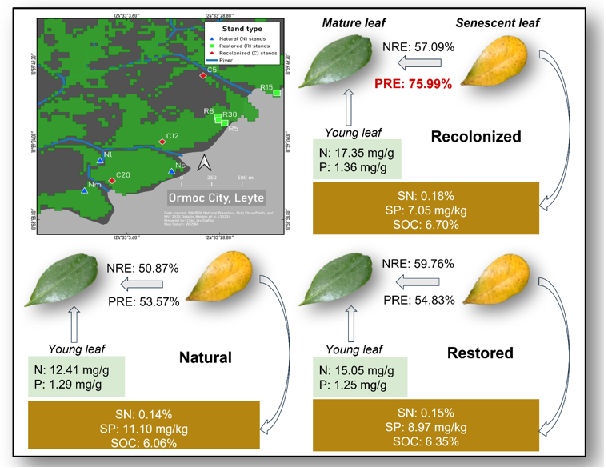
FINDINGS: While there was a marked difference in the nutrient composition of soil and leaves across various stand types, the data did not indicate any clear age-related patterns in the restored and recolonized stands. Soil nutrients were not correlated with leaf nutrients suggesting that soil nutrient availability does not necessarily translate to nutrient absorption and accumulation in the leaves. Nitrogen resorption efficiency is similar across stand types. Phosphorus resorption efficiency was highest (76 percent) in recolonized stands suggesting that phosphorus resorption is an adaptive strategy to meet phosphorus demand. Conventional indices of leaf nitrogen to phosphorus and nitrogen resorption efficiency to phosphorus resorption efficiency ratios as indicators of nutrient limitations (as used in other terrestrial systems) may not be applicable in disturbed mangroves because of apparent long-term impacts on soil nutrients following pond construction, operation, and abandonment. Recolonized stands exhibited high phosphorus resorption resulting in low phosphorus concentration of senescent leaves and consequently, low phosphorus input of senescent leaves to soil phosphorus pool.
CONCLUSION: This study demonstrated variations in soil nitrogen and phosphorus, leaf nitrogen and phosphorus, leaf nitrogen and phosphorus ratio, and nutrient resorption efficiencies of nitrogen and phosphorus across stand types and ages. Conventional indices for nutrient limitation of nitrogen and phosphorus using leaf nitrogen to phosphorus and nitrogen resorption efficiency to phosphorus resorption efficiency ratios showed inconsistent indicator of nutrient limitations in mangroves. Hence, a mangrove-specific leaf nitrogen to phosphorus ratio and nitrogen resorption efficiency to phosphorus resorption efficiency ratio are suggested as a more appropriate indicator of nutrient limitation.
Graphical Abstract
Highlights
- Soil and leaf nutrient (N and P) concentrations did not increase with age in restored ‘planted’ and recolonized stands;
- Phosphorus resorption efficiency (PRE) was highest in recolonized stands (76%) suggesting that phosphorus (P) resorption is an important strategy to meet P demand;
- The high PRE in recolonized stands results to low P concentration of senescent leaves and low P input of senescent leaves to soil P pool;
- Conventional indices to assess nutrient limitation of nitrogen (N) and phosphorus (P) using leaf N:P ratio and NRE:PRE ratio showed inconsistent nutrient limitations in mangroves.
Keywords
Subjects
OPEN ACCESS
©2024 The author(s). This article is licensed under a Creative Commons Attribution 4.0 International License, which permits use, sharing, adaptation, distribution and reproduction in any medium or format, as long as you give appropriate credit to the original author(s) and the source, provide a link to the Creative Commons license, and indicate if changes were made. The images or other third party material in this article are included in the article’s Creative Commons license, unless indicated otherwise in a credit line to the material. If material is not included in the article’s Creative Commons license and your intended use is not permitted by statutory regulation or exceeds the permitted use, you will need to obtain permission directly from the copyright holder. To view a copy of this license, visit:
http://creativecommons.org/licenses/by/4.0/
PUBLISHER NOTE
GJESM Publisher remains neutral concerning jurisdictional claims in published maps and institutional affiliations.
CITATION METRICS & CAPTURES
Google Scholar | Scopus | Web of Science | PlumX Metrics | Altmetrics | Mendeley |
CURRENT PUBLISHER
GJESM Publisher




Letters to Editor
[1] Letters that include statements of statistics, facts, research, or theories should include appropriate references, although more than three are discouraged.
[2] Letters that are personal attacks on an author rather than thoughtful criticism of the author’s ideas will not be considered for publication.
[3] Letters can be no more than 300 words in length.
[4] Letter writers should include a statement at the beginning of the letter stating that it is being submitted either for publication or not.
[5] Anonymous letters will not be considered.
[6] Letter writers must include their city and state of residence or work.
[7] Letters will be edited for clarity and length.