Document Type : CASE STUDY
Authors
1
Postgraduate School, Universitas Sebelas Maret, Surakarta, Central Java, Indonesia
2
Department of Chemistry, Faculty of Mathematics and Natural Sciences, Universitas Sebelas Maret, Surakarta, Central Java, Indonesia
3
Department of Biology, Faculty of Mathematics and Natural Sciences, Universitas Sebelas Maret, Surakarta, Central Java, Indonesia
4
Study Program of Chemical Engineering, Faculty of Engineering, Universitas Sebelas Maret, Surakarta, Indonesia
5
Research Center for Animal Husbandry, National Research and Innovation Agency, Cibinong, Bogor, Indonesia
6
Research Centre for Sustainable Production System and Life Cycle Assessment, National Research and Innovation Agency, Serpong, Tangerang Selatan, Indonesia
7
Research Center for Food Crops, National Research and Innovation Agency, Cibinong, Bogor, Indonesia
Abstract
BACKGROUND AND OBJECTIVES: The livestock sector contributes to increasing greenhouse gas emissions. The emissions generated from livestock mainly originate from enteric fermentation, which is strongly influenced by feed quality. The utilization of fermented rice straw as a source of crude fiber for animal feed is one solution for providing high-quality feed. Central Java is one of the centers of cattle farming and rice production in Indonesia. The purpose of this study was to determine the contribution of greenhouse gas emissions resulting from fermented straw feed formula commonly practiced by cattle farmers in Central Java.
METHODS: Greenhouse gas production was conducted in vitro using three formulas arranged in a completely randomized design with six replications. The three feed formula treatments were: 30 percent king grass + 35 percent rice bran+ 35 percent wheat bran (treatment one), 30 percent fermented rice straw + 35 percent rice bran + 35 percent wheat bran (treatment two), and 30 percent fermented rice straw + 70 percent concentrate (treatment three). Feed nutrient content and enteric gas production were analyzed to determine the quality of the feed formula as well as to determine feed digestibility and greenhouse gas production during the digestion process. The gas production was measured at regular intervals of 8, 16, 24, 36, and 48 hours. The methane, nitrous oxide, and carbon dioxide contents were analyzed using gas chromatography. Data on nutrient content and digestibility of dry matter and organic matter were analyzed using analysis of variance, and the estimated greenhouse gas emissions were calculated using the ideal gas equation approach.
FINDINGS: The quality of the feed formula influences the amountof greenhouse gases emission produced by enteric fermentation processes. The feed quality of treatment one was equivalent to that of treatment two. The treatment three feed formulation had a crude protein content approximately 3 percent higher than that of treatment one and treatment two. The digestibility of dry matter and organic matter values did not show significant differences between the treatments. The feed formula treatment two can reduce potential greenhouse gas emissions by 1.81 percent from treatment one, whereas treatment three can reduce potential greenhouse gas emissions by 27.78 percent from treatment one and by 26.4 percent from treatment two. These results indicate that feed formulas with higher crude protein content have greater potential to reduce greenhouse gas emissions. This finding can be used to mitigate and develop strategies to improve feed quality by utilizing agricultural waste as a broader low greenhouse gas emission livestock management effort
CONCLUSION: Utilization of fermented straw has the potential to reduce greenhouse gas emissions resulting from enteric fermentation and contamination of unutilized straw waste and has the opportunity to reduce land use and greenhouse gas emissions from forage plants. Efforts to utilize fermented straw as a low greenhouse gas emission feed need to be followed by improvements in feed quality. More comprehensive studies need to be carried out on the variations in feed formulas based on differences in regional resources, the economic feasibility of utilizing fermented straw combined with various feed ingredients, and the life cycle assessment of straw utilization as a feed ingredient based on geographical, social, economic, technological, and environmental dimensions.
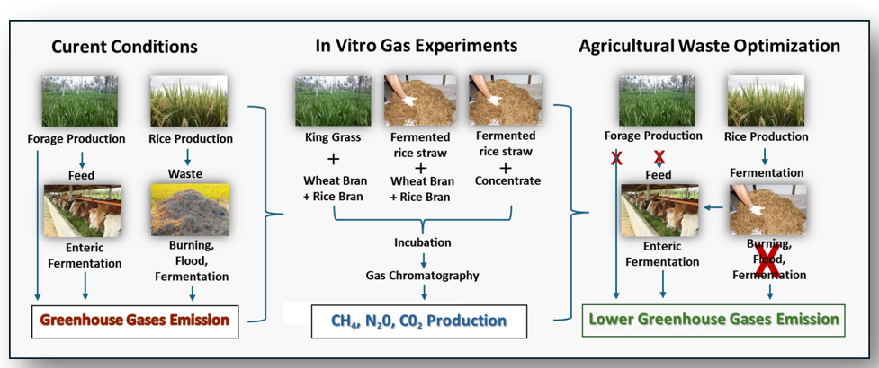
Graphical Abstract
Highlights
- Animal feed formulae using fermented straw are of comparable quality to feed formulas including king grass;
- The feed formula employing fermented straw may create lower GHG emissions from the enteric fermentation process than the feed formula utilizing king grass;
- The use of fermented straw as animal feed has an indirect positive influence on lowering GHG emissions from unused agricultural waste and forage crop production, as well as reducing land usage for forage crops;
- This study is unique in that it reveals possible GHG emissions from enteric fermentation of feed formulae of varying feed quality that are routinely used by cattle ranchers in Central Java.
Keywords
Subjects
OPEN ACCESS
©2024 The author(s). This article is licensed under a Creative Commons Attribution 4.0 International License, which permits use, sharing, adaptation, distribution and reproduction in any medium or format, as long as you give appropriate credit to the original author(s) and the source, provide a link to the Creative Commons license, and indicate if changes were made. The images or other third party material in this article are included in the article’s Creative Commons license, unless indicated otherwise in a credit line to the material. If material is not included in the article’s Creative Commons license and your intended use is not permitted by statutory regulation or exceeds the permitted use, you will need to obtain permission directly from the copyright holder. To view a copy of this license, visit:
http://creativecommons.org/licenses/by/4.0/
PUBLISHER NOTE
GJESM Publisher remains neutral concerning jurisdictional claims in published maps and institutional affiliations.
CITATION METRICS & CAPTURES
Google Scholar | Scopus | Web of Science | PlumX Metrics | Altmetrics | Mendeley |
CURRENT PUBLISHER
GJESM Publisher



Letters to Editor
[1] Letters that include statements of statistics, facts, research, or theories should include appropriate references, although more than three are discouraged.
[2] Letters that are personal attacks on an author rather than thoughtful criticism of the author’s ideas will not be considered for publication.
[3] Letters can be no more than 300 words in length.
[4] Letter writers should include a statement at the beginning of the letter stating that it is being submitted either for publication or not.
[5] Anonymous letters will not be considered.
[6] Letter writers must include their city and state of residence or work.
[7] Letters will be edited for clarity and length.