Document Type : RESEARCH ARTICLE
Authors
1
Research Center for Applied Microbiology, Research Organization for Life Sciences and Environment, National Research and Innovation Agency, Jalan Raya Jakarta-Bogor, Cibinong, Jawa Barat, 16911 Indonesia
2
Research Centre of Applied Botany, Research Organization for Life Sciences and Environment, National Research and Innovation Agency, Jalan Raya Jakarta-Bogor, Cibinong, Jawa Barat, 16911 Indonesia
3
Department of Agricultural Science and Center of Excellence for Local Food Innovation, Sultan Ageng Tirtayasa University, Serang, Indonesia
Abstract
BACKGROUND AND OBJECTIVES: Falcataria moluccana is a potential forest tree species with high economic value in Indonesia, and it is widely planted in various forests and landscape restorations. F. moluccana planting has declined in productivity due to decreased site quality and pest and disease attacks. Dark septate endophytes are a group of root endophytic fungi that have potential as biological control and promoter agents. This research aims to test the symbiotic potential of several dark septate endophytes isolates, to determine the effect of dark septate endophytes on the germination of F. moluccana seeds, and what types of secondary metabolites are produced from this symbiotic interaction.
METHODS: Three dark septate endophytes isolates, i.e., Rhizopycnis vagum, Curvularia sp., and Dendrothyrium sp. were used in this study. Those isolates were inoculated on the seeds of F. moluccana and observed the endophytism and metabolite compounds produced after 23 hours and 14 days of inoculation time.
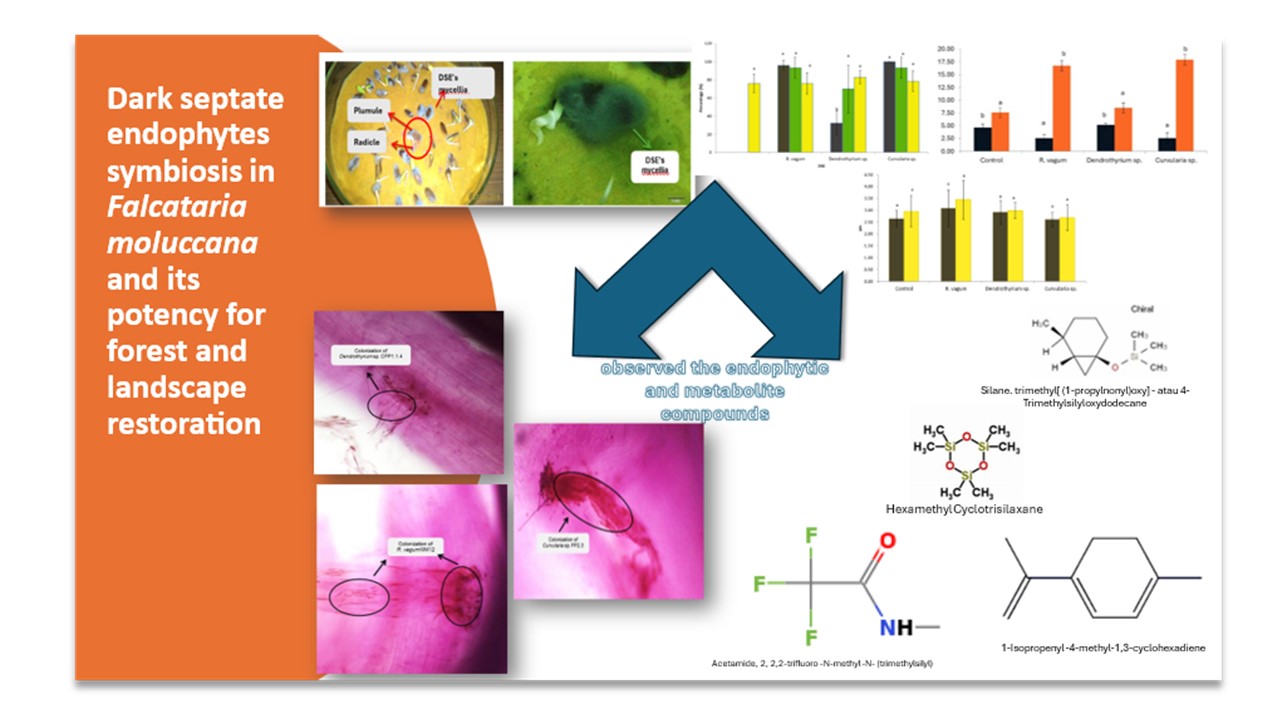
FINDINGS: Three new findings of this study were: 1) the dark septate endophytes isolates, i.e., Rhizopycnis vagum, Curvularia sp., and Dendrothyrium sp. could colonize F. moluccana seeds on the surface with a colonization rate of 96 percent, 32.5 percent, and 100 percent, and entered the seed tissue and the sprout roots with a colonization rate of 93.3 percent, 93.3 percent, and 70 percent. The dark septate endophytes colonization could be seen at the beginning of germination, inoculation of 0-23 hours, and after germination until observation at the age of 14 days; 2) The dark septate endophytes has the potential to improve seed germination and vigor of F. moluccana, by speeding up the germination process and increasing the vigor index, this condition is expected to produce seeds that can grow and survive environmental stress; 3) The dark septate endophytes has the potential to trigger an increase secondary metabolite compounds in F. moluccana seeds, which can be as antibacterial, antifungal, and antioxidants such as the Hexamethyl Cyclotrisilaxane compound, 1-Isopropenyl-4-methyl-1,3-cyclohexadiene, and Acetamide, 2, 2,2-trifluoro-N-methyl-N- (trimethylsilyl) as a form of plant protection when the F. moluccana seeds grew and developed to be a normal seedling. These conditions are believed to produce high-quality seedlings that can grow and adapt well to their new environment after being outplanted.
CONCLUSION: Dark septate endophytes colonization of F. moluccana seeds does not reduce seed viability, so dark septate endophytes inoculation of seeds can be used as a seed treatment and can produce healthy and vigorous F. moluccana seedlings, thereby increasing the success of planting in the context of restoration of degraded forest and landscape.
Graphical Abstract
Highlights
- The DSE (Rhizopycnis vagum, Curvularia , and Dendrothyrium sp.) could colonize F. moluccana seeds on the surface with a colonization rate of 96 percent, 32.5 percent, and 100 percent, and entered the seed tissue and the sprout roots with a colonization rate of 93.3 percent, 93.3 percent, and 70 percent;
- The DSE inoculation of moluccana seeds could be used as seed treatment and can produce healthy F. moluccana seedlings from the beginning of the nursery;
- The DSE has the potential to improve seed germination and vigor of moluccana, by speeding up the germination process and increasing the vigor index;
- The DSE potentially triggers the increment of secondary metabolite compounds (Hexamethyl Cyclotrisilaxane compound, 1-Isopropenyl-4-methyl-1,3-cyclohexadiene, and Acetamide) in Falcataria moluccana seeds as a form of plant protection.
Keywords
Subjects
OPEN ACCESS
©2024 The author(s). This article is licensed under a Creative Commons Attribution 4.0 International License, which permits use, sharing, adaptation, distribution and reproduction in any medium or format, as long as you give appropriate credit to the original author(s) and the source, provide a link to the Creative Commons license, and indicate if changes were made. The images or other third party material in this article are included in the article’s Creative Commons license, unless indicated otherwise in a credit line to the material. If material is not included in the article’s Creative Commons license and your intended use is not permitted by statutory regulation or exceeds the permitted use, you will need to obtain permission directly from the copyright holder. To view a copy of this license, visit:
http://creativecommons.org/licenses/by/4.0/
PUBLISHER NOTE
GJESM Publisher remains neutral concerning jurisdictional claims in published maps and institutional affiliations.
CITATION METRICS & CAPTURES
Google Scholar | Scopus | Web of Science | PlumX Metrics | Altmetrics | Mendeley |
CURRENT PUBLISHER
GJESM Publisher



Letters to Editor
[1] Letters that include statements of statistics, facts, research, or theories should include appropriate references, although more than three are discouraged.
[2] Letters that are personal attacks on an author rather than thoughtful criticism of the author’s ideas will not be considered for publication.
[3] Letters can be no more than 300 words in length.
[4] Letter writers should include a statement at the beginning of the letter stating that it is being submitted either for publication or not.
[5] Anonymous letters will not be considered.
[6] Letter writers must include their city and state of residence or work.
[7] Letters will be edited for clarity and length.