Radiation hazards from natural radionuclides contained in rice from former tin mining land

Document Type : CASE STUDY

Authors

1 Research Center for Safety, Metrology, and Nuclear Quality Technology, National Research and Innovation Agency, PUSPIPTEK Serpong, South Tangerang, 15314, Indonesia

2 Research Center of Radiation Processing Technology, National Research and Innovation Agency, PUSPIPTEK Serpong, South Tangerang, 15314, Indonesia

3 Department of Biology, Universitas Bangka Belitung, Merawang, Bangka Belitung Island, Indonesia

Abstract
BACKGROUND AND OBJECTIVES: Rice (Oryza sativa L) cultivated at former tin mining land has the potential to absorb natural radionuclides from the soil where it grows. Radionuclides found in rice can potentially lead to exposure to ionizing radiation, thereby influencing the likelihood of developing. The aim of study is to assess the levels of natural radionuclides in rice, calculate the annual effective dose, and evaluate the additional lifetime cancer risk resulting from radiation exposure via the consumption of rice.
METHODS: Rice sampling was carried out, then 1 kilogram was weighed and sealed in a standard Marinelli container. Placed for approximately 30 days before gamma spectrometer measurements to allow the decay products to reach secular equilibrium. Utilizing a high purity germanium detector, the radioactivity of the samples was quantified through a gamma spectrometer. Data obtained to calculate daily intake of radionuclides, annual effective dose, and Lifetime Cancer Risk probability.
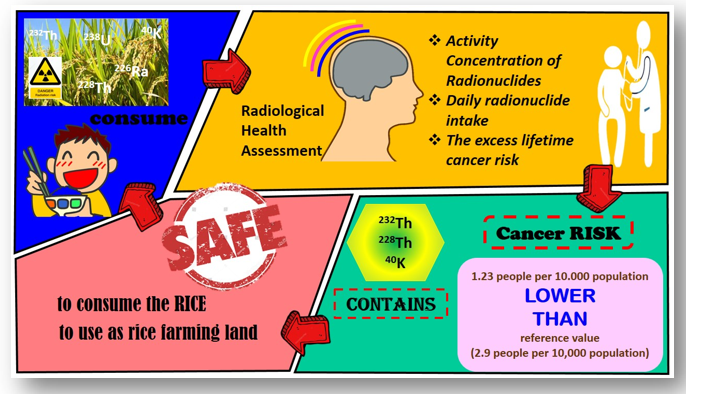
FINDINGS: Rice sourced from previous tin mining areas in Indonesia has been considered safe for consumption. While radium and uranium were not detected in the rice, elevated levels of Thorium and Potassium were observed, exceeds the reference value. The estimated annual effective dose that people receive by consuming rice is still lower than the annual limit for the general public recommendation and the world average. The estimated risk of Indonesian people getting cancer due to rice consumption is 1.23 people per 10,000 population, lower than reference value (2.9 people per 10,000 population). The absence of cancer risk associated with this method indicates that the agricultural land in Bangka Belitung Province remains suitable for rice cultivation. This finding has holds significance within the realm of environmental risk assessment.
CONCLUSION: Rice samples obtained from former tin mining land actually did not contain the natural radionuclides radium and uranium, but radionuclides thorium and potassium were found. The concentrations of radionuclides thorium and potassium exhibited variations in activity levels, surpassing the reference value but remaining below the global average threshold. The annual effective dose is still lower than the average annual intake dose in the world. The estimated risk of cancer from consuming rice was found to be 1.23 people per 10,000 population or a range of 0.55 to 2.67 people per 10,000 population who are potentially at risk of developing cancerThe lifetime risk of cancer-related death is reported to be lower than the public recommendation, with 2.9 individuals per 10,000 population being affected. Rice consumers from former tin mining areas in Indonesia (Bangka) continue to be classified as safe.

Graphical Abstract

Radiation hazards from natural radionuclides contained in rice from former tin mining land

Highlights

  • Rice originating from former tin mining land did not contain the radionuclides radium and uranium, but Thorium, and Potassium were found with values exceeding the reference value;
  • The estimated annual effective dose that people receive by consuming rice is still lower than the annual limit for the general public recommendation and the world average;
  • The estimated risk of Indonesian people getting cancer due to rice consumption is 1.23 people per 10,000 population, lower than reference value (2.9 people per 10,000 population).

Keywords

Subjects

OPEN ACCESS

©2024 The author(s). This article is licensed under a Creative Commons Attribution 4.0 International License, which permits use, sharing, adaptation, distribution and reproduction in any medium or format, as long as you give appropriate credit to the original author(s) and the source, provide a link to the Creative Commons license, and indicate if changes were made. The images or other third party material in this article are included in the article’s Creative Commons license, unless indicated otherwise in a credit line to the material. If material is not included in the article’s Creative Commons license and your intended use is not permitted by statutory regulation or exceeds the permitted use, you will need to obtain permission directly from the copyright holder. To view a copy of this license, visit: 

http://creativecommons.org/licenses/by/4.0/


PUBLISHER NOTE

GJESM Publisher remains neutral concerning jurisdictional claims in published maps and institutional affiliations.


CITATION METRICS & CAPTURES

Google Scholar | Scopus | Web of Science | PlumX Metrics | Altmetrics | Mendeley |


CURRENT PUBLISHER

GJESM Publisher

Letters to Editor

GJESM Journal welcomes letters to the editor for the post-publication discussions and corrections which allows debate post publication on its site, through the Letters to Editor. Letters pertaining to manuscript published in GJESM should be sent to the editorial office of GJESM within three months of either online publication or before printed publication, except for critiques of original research. Following points are to be considering before sending the letters (comments) to the editor.

[1] Letters that include statements of statistics, facts, research, or theories should include appropriate references, although more than three are discouraged.
[2] Letters that are personal attacks on an author rather than thoughtful criticism of the author’s ideas will not be considered for publication.
[3] Letters can be no more than 300 words in length.
[4] Letter writers should include a statement at the beginning of the letter stating that it is being submitted either for publication or not.
[5] Anonymous letters will not be considered.
[6] Letter writers must include their city and state of residence or work.
[7] Letters will be edited for clarity and length.

Send comment about this article
Enter Name.
Enter a valid email address.
Enter a vaid affiliation.
Enter comments (At leaset 10 words)
CAPTCHA Image
Enter Security Code Correctly.

Article Podcasts

  • Receive Date 19 March 2024
  • Revise Date 23 May 2024
  • Accept Date 29 July 2024