Document Type : CASE STUDY
Authors
1
Waste Management Portfolio, Deutsche Gesellschaft fur Internationale Zusammenarbeit GmbH, Amman, Jordan
2
Agricultural and Irrigation Engineering. Department of Land, Water and Environment, The University of Jordan, Amman 11942, Jordan
3
Water and Environment Engineering, Department of Land, Water and Environment, The University of Jordan, Amman 11942, Jordan
Abstract
BACKGROUND AND OBJECTIVES: Jordan faces significant food security challenges due to population growth, climate change, and urbanization, straining limited water resources. Water supply expansion is constrained by economic and environmental factors, leading to a critical impact on agriculture, which stands as the largest consumer of water. The study emphasizes the crucial importance of regional water sources in ensuring food security, as the quantity and quality of irrigation water have a direct influence on crop yield and productivity. Managing irrigation is crucial for sustainability and livelihoods, given Jordan's reliance on food imports and climate change-induced production variability. This study delves into potato cultivation, examining the interconnections among irrigation water availability, crop yield, and self-reliance
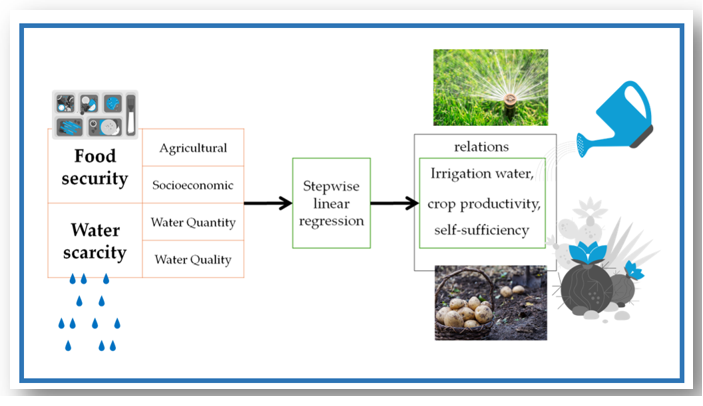
METHODS: Irrigation with freshwater and blended treated wastewater in the middle and northern Jordan Valley is compared, using stepwise regression analysis and assuming other agricultural inputs to be optimal. Food security indicators, which include agricultural and socio-economic factors, along with water scarcity indicators, encompassing both water quantity and quality, were methodically chosen and examined.
FINDINGS: Regression analysis of potato production in Jordan revealed that increased blended water positively impacts yields, while higher water requirements and chloride levels negatively affect them. The negative implications of effective rainfall in combined water irrigation were evident, emphasizing the necessity for precise control over the levels of water quality and quantity. The study found that higher local potato production enhances self-sufficiency, crucial for food security. Enhanced water management techniques and advancements in agricultural practices have led to an increase in potato self-sufficiency, even in the face of dwindling water resources. Challenges from stable water requirements and decreasing rainfall can be addressed with advanced irrigation techniques and adaptive practices.
CONCLUSION: Improved water and crop management contribute to enhanced potato self-sufficiency in Jordan, despite varying water quality parameters. Furthermore, the results of research offer important information regarding the adjustment of potato cultivation to evolving climate patterns, including changes in precipitation temperature. These adaptation strategies can be shared and implemented in other countries facing similar climatic challenges.
Graphical Abstract
Highlights
- Jordan faces food security challenges due to population growth, climate change, and urbanization;
- Effective irrigation management is crucial amid increased food imports and climate-driven production changes;
- Blended treated wastewater boosts potato yields, but high water requirements, chloride, and effective rainfall lower them;
- Increased potato production boosts self-sufficiency, crucial for food security, highlighting better water and crop management.
Keywords
Subjects
OPEN ACCESS
©2024 The author(s). This article is licensed under a Creative Commons Attribution 4.0 International License, which permits use, sharing, adaptation, distribution and reproduction in any medium or format, as long as you give appropriate credit to the original author(s) and the source, provide a link to the Creative Commons license, and indicate if changes were made. The images or other third party material in this article are included in the article’s Creative Commons license, unless indicated otherwise in a credit line to the material. If material is not included in the article’s Creative Commons license and your intended use is not permitted by statutory regulation or exceeds the permitted use, you will need to obtain permission directly from the copyright holder. To view a copy of this license, visit:
http://creativecommons.org/licenses/by/4.0/
PUBLISHER NOTE
GJESM Publisher remains neutral concerning jurisdictional claims in published maps and institutional affiliations.
CITATION METRICS & CAPTURES
Google Scholar | Scopus | Web of Science | PlumX Metrics | Altmetrics | Mendeley |
CURRENT PUBLISHER
GJESM Publisher




Letters to Editor
[1] Letters that include statements of statistics, facts, research, or theories should include appropriate references, although more than three are discouraged.
[2] Letters that are personal attacks on an author rather than thoughtful criticism of the author’s ideas will not be considered for publication.
[3] Letters can be no more than 300 words in length.
[4] Letter writers should include a statement at the beginning of the letter stating that it is being submitted either for publication or not.
[5] Anonymous letters will not be considered.
[6] Letter writers must include their city and state of residence or work.
[7] Letters will be edited for clarity and length.