Exploring the potential of palm oil plantation waste for local communities using mixed methods

Document Type : CASE STUDY

Authors

Faculty of Mathematics and Natural Science Education, Universitas Pendidikan Indonesia, Indonesia

Abstract
BACKGROUND AND OBJECTIVES: Riau is Indonesia's largest palm oil supplier region, part of which is managed by smallholder farmers. The escalation in the worldwide need for palm oil has resulted in the expansion of plantations, consequently causing a rise in palm oil waste. Small-scale farmers lack sufficient knowledge and resources for waste management. The study seeks to estimate and forecast the volume of palm oil waste generated and the utilization inventory by indigenous populations in Riau province.
METHODS: The present study employs a combination of quantitative and qualitative methodologies. Utilizing secondary data obtained from the Central Statistics Agency, the research calculates the volume of waste generated by smallholder oil palm plantations and forecasts the quantity of palm oil waste. The prediction method uses the time series modeler method with the help of a statistical package for the social sciences 23. Subsequently, surveys were employed to gather quantitative information regarding the utilization of palm oil waste by indigenous populations in the province of Riau. The respondents involved were 112 people using the convenience sampling method. Descriptive statistics are utilized in data analysis to determine the quantity of waste and to gain insight into the local population's utilization. Interviews were also conducted with seven local people who work as farmers regarding the management and use of palm oil waste. Interview data were analyzed using descriptive qualitative methods.
FINDINGS: Analysis of smallholder plantation waste in Riau shows that the most significant type is stem parts at 82 percent. Palm oil waste will increase to 236.37 million tons in the next decade. Approximately 80 percent of local communities handle plantation waste by depositing it on plantations for natural decomposition.
CONCLUSION: The amount of smallholder plantation waste is enormous and will continue to increase. It is crucial to prioritize the improvement of waste management standards at the local community level in order to promote the sustainability of palm oil plantations. The findings significantly contribute to promoting sustainable environmental management, providing actionable insights for policymakers and environmental activists.

Graphical Abstract

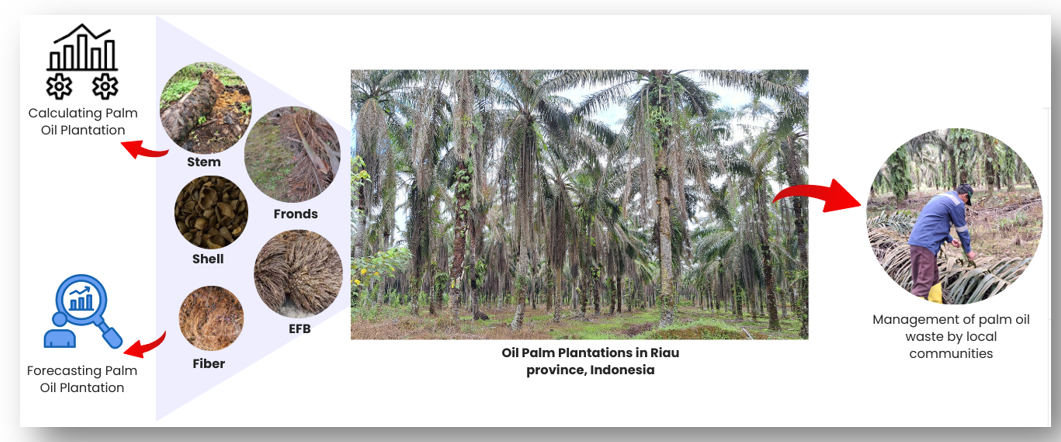
Exploring the potential of palm oil plantation waste for local communities using mixed methods

Highlights

  • Stem and frond waste comprise the most significant portion of oil palm plantation waste, averaging 82% and 13%, respectively between 2006 and 2022;
  • A significant positive correlation exists between oil palm land expansion and the resulting increase in palm oil waste;
  • Predictions estimate a total palm oil waste volume of 236.37 million tons for the next decade, with a breakdown of 6.37 million tons for EFB, 1.94 million tons for shells, 4.3 million tons for fiber, 31 million tons for fronds, and 192.26 million tons for stems;
  • Local communities demonstrate limited utilization of palm oil waste, primarily for composting and firewood.

Keywords

Subjects

OPEN ACCESS

©2024 The author(s). This article is licensed under a Creative Commons Attribution 4.0 International License, which permits use, sharing, adaptation, distribution and reproduction in any medium or format, as long as you give appropriate credit to the original author(s) and the source, provide a link to the Creative Commons license, and indicate if changes were made. The images or other third party material in this article are included in the article’s Creative Commons license, unless indicated otherwise in a credit line to the material. If material is not included in the article’s Creative Commons license and your intended use is not permitted by statutory regulation or exceeds the permitted use, you will need to obtain permission directly from the copyright holder. To view a copy of this license, visit: 

http://creativecommons.org/licenses/by/4.0/


PUBLISHER NOTE

GJESM Publisher remains neutral concerning jurisdictional claims in published maps and institutional affiliations.


CITATION METRICS & CAPTURES

Google Scholar | Scopus | Web of Science | PlumX Metrics | Altmetrics | Mendeley |


CURRENT PUBLISHER

GJESM Publisher

Letters to Editor

GJESM Journal welcomes letters to the editor for the post-publication discussions and corrections which allows debate post publication on its site, through the Letters to Editor. Letters pertaining to manuscript published in GJESM should be sent to the editorial office of GJESM within three months of either online publication or before printed publication, except for critiques of original research. Following points are to be considering before sending the letters (comments) to the editor.

[1] Letters that include statements of statistics, facts, research, or theories should include appropriate references, although more than three are discouraged.
[2] Letters that are personal attacks on an author rather than thoughtful criticism of the author’s ideas will not be considered for publication.
[3] Letters can be no more than 300 words in length.
[4] Letter writers should include a statement at the beginning of the letter stating that it is being submitted either for publication or not.
[5] Anonymous letters will not be considered.
[6] Letter writers must include their city and state of residence or work.
[7] Letters will be edited for clarity and length.

Send comment about this article
Enter Name.
Enter a valid email address.
Enter a vaid affiliation.
Enter comments (At leaset 10 words)
CAPTCHA Image
Enter Security Code Correctly.

Article Podcasts

  • Receive Date 19 March 2024
  • Revise Date 21 May 2024
  • Accept Date 24 July 2024